Welcome to our guide to plastic decking in NZ, where you will learn how plastic decking performs in New Zealand conditions, what it costs, how it compares with timber and composite decking, and what to check before choosing a product. Plastic decking can offer strong moisture resistance, low maintenance, and long-term durability, but the right result depends on product quality, climate, installation, heat exposure, slip resistance, and warranty terms. This guide gives you clear, practical information to help you compare options, avoid common mistakes, and decide whether plastic decking suits your home, budget, and outdoor space.
Plastic decking in NZ is a low-maintenance decking option made from PVC, HDPE, or recycled plastic. It resists moisture, rot, and insects, making it suitable for wet and coastal areas. Costs vary by product, deck size, framing, site access, and installation requirements.
Table of Contents
What Is Plastic Decking?
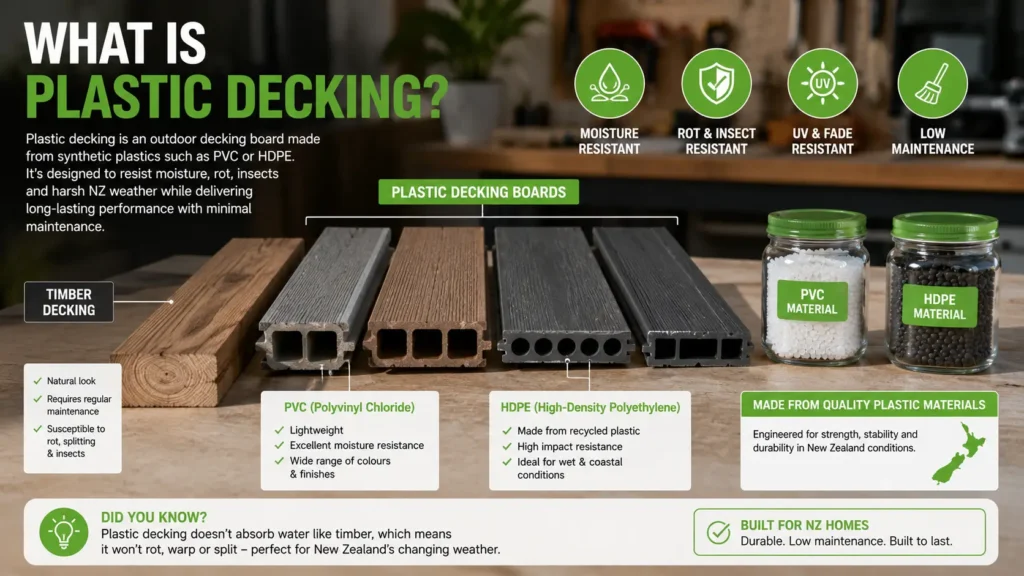
Plastic decking is an outdoor decking material manufactured primarily from synthetic plastics instead of natural wood. It has become a popular choice for New Zealand homeowners looking for a deck that requires less ongoing maintenance while offering good resistance to moisture, rot, and insect damage. Although the term “plastic decking” is sometimes used interchangeably with composite decking, the two products are not the same. Understanding how plastic decking is made and how it compares with composite decking will help you choose the most suitable option for your property, budget, and long-term maintenance expectations.
How Plastic Decking Is Made
Plastic decking boards are manufactured using synthetic plastics that are designed to withstand outdoor conditions. Depending on the manufacturer and product range, the boards may be produced from recycled plastic, virgin plastic, or a combination of both.
Recycled plastic decking uses plastic materials that have already been used for other purposes before being processed into new decking boards. This approach helps reduce plastic waste while giving existing materials a second life. The quality of recycled products can vary, so it is important to choose boards from manufacturers that maintain consistent production standards and provide clear product specifications.
Virgin plastic decking is produced using newly manufactured plastic resins. Because the material has not previously been recycled, manufacturers often have greater control over colour consistency, structural performance, and manufacturing tolerances. Some premium decking products use virgin materials to achieve specific strength, durability, or appearance requirements.
Two of the most common materials used in plastic decking are PVC and HDPE.
- PVC (Polyvinyl Chloride): PVC decking is lightweight, highly resistant to moisture, and available in a wide range of colours and surface finishes. Many PVC products are designed with textured surfaces that improve grip while also resisting stains and fading.
- HDPE (High-Density Polyethylene): HDPE decking is known for its durability, impact resistance, and ability to perform well in wet environments. It is commonly used in products made from recycled plastics and is often selected for areas exposed to frequent rain or coastal conditions.
Unlike traditional timber decking, plastic decking does not contain natural wood fibres that absorb water. This means the boards are less likely to experience problems such as rot, splitting, warping, or insect attack. While no decking material is completely maintenance-free, plastic decking generally requires regular cleaning rather than ongoing treatments such as staining, painting, or oiling.
Plastic boards also have different structural properties from timber. They expand and contract as temperatures change, which is why manufacturers provide specific installation instructions covering board spacing, fixing systems, and ventilation. Following these requirements helps maintain the appearance and performance of the deck over time.
Plastic Decking Versus Composite Decking
Plastic decking and composite decking are often grouped together because they both offer low-maintenance alternatives to timber. In reality, they are manufactured differently and have distinct performance characteristics that homeowners should understand before making a decision.
Fully plastic decking is made almost entirely from synthetic plastic materials such as PVC or HDPE. Composite decking, on the other hand, combines plastic with wood fibres, wood flour, or other natural materials to create a board that more closely resembles the appearance of real timber.
One of the biggest differences is appearance. Composite decking often features wood-grain textures and colour variations that mimic natural timber, making it a popular choice for homeowners who prefer a traditional timber look without the same level of maintenance. Plastic decking usually has a more consistent finish and may appear slightly more uniform across every board.
The feel underfoot also differs. Composite decking generally feels firmer because of its wood content, while fully plastic decking may have a slightly smoother surface depending on the product and texture. Modern plastic decking products are available with embossed finishes that improve grip and create a more natural appearance.
Weight is another factor worth considering. Composite boards are often heavier because they contain wood fibres as well as plastic. Fully plastic boards can be lighter, although this varies between manufacturers and board profiles. Installation methods and structural requirements should always follow the manufacturer’s recommendations rather than assumptions based on weight alone.
Thermal movement is another important difference. Fully plastic decking tends to expand and contract more noticeably as temperatures rise and fall. Manufacturers address this by specifying expansion gaps, fastening systems, and maximum joist spacing. Composite decking also expands with temperature changes, but the amount of movement may differ depending on the product formulation.
Maintenance requirements are relatively low for both materials, but there are small differences. Plastic decking typically offers excellent resistance to moisture because it contains no wood fibres. Composite decking also performs well outdoors but may require more attention to cleaning depending on the product, surface finish, and surrounding environment.
Price varies across both categories. Entry-level and premium products exist for both plastic and composite decking, so there is no universal price advantage. Factors such as board profile, warranty length, surface technology, recycled content, and manufacturer reputation usually have a greater impact on cost than whether the board is plastic or composite.
When comparing products, avoid relying on marketing terms alone. Review the technical specifications, warranty conditions, installation requirements, slip resistance, UV performance, and local product support before making a decision. Understanding these differences will help you choose a decking material that matches your property’s conditions and your expectations for long-term performance.
Choosing between plastic decking and composite decking is not simply about selecting the most expensive option. It is about finding the material that offers the right balance of appearance, durability, maintenance, and value for your specific project. Taking the time to compare products carefully will help you invest in a deck that performs well for many years.
Is Plastic Decking Suitable For New Zealand Conditions?
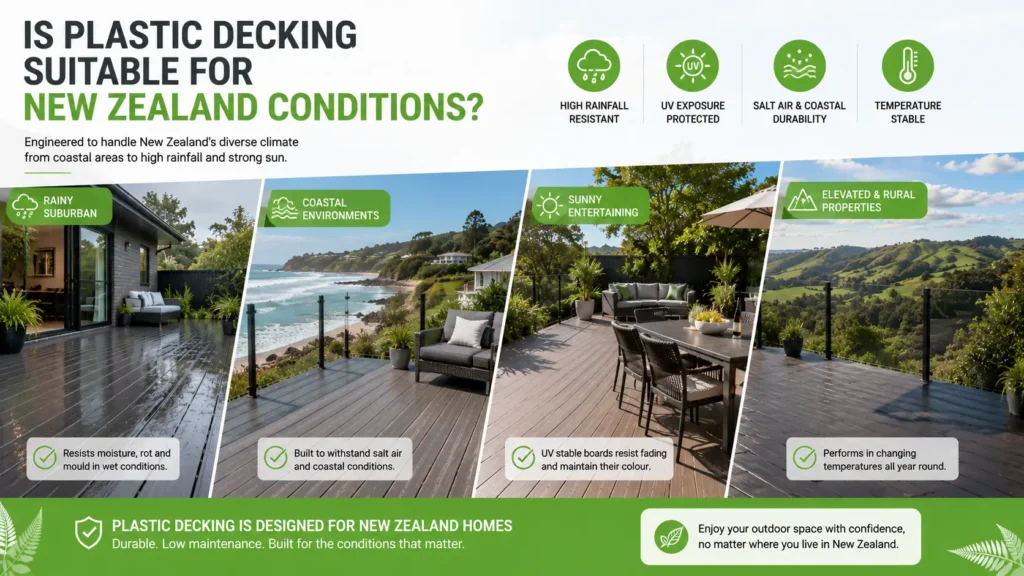
New Zealand’s climate can vary significantly from one region to another. Some homes experience heavy rainfall throughout the year, while others are exposed to strong UV levels, coastal salt spray, or large temperature changes between seasons. These conditions can influence how well any decking material performs over time. Plastic decking is often chosen because it offers excellent moisture resistance and requires very little maintenance, but its long-term performance still depends on selecting a quality product that is suitable for the local environment and installing it correctly.
Performance In Rain And Coastal Areas
One of the biggest advantages of plastic decking is its ability to handle wet conditions. Unlike traditional timber, plastic boards do not absorb water in the same way, which helps reduce many of the problems commonly associated with prolonged moisture exposure. This makes plastic decking a popular choice for homes in high-rainfall areas and coastal locations throughout New Zealand.
Because plastic decking absorbs very little moisture, it is less likely to suffer from issues that often affect untreated or poorly maintained timber decks.
- Moisture resistance: Plastic decking is designed to repel water, helping minimise swelling, cracking, and moisture-related deterioration.
- Rot resistance: Since the boards do not provide the same conditions that encourage timber decay, they are not susceptible to rot caused by prolonged wet weather.
- Mold resistance: Surface mould can still develop if dirt, leaves, and moisture are allowed to accumulate, but the decking material itself does not provide a food source in the way natural timber does. Regular cleaning helps maintain both appearance and safety.
- Salt exposure: Coastal environments expose outdoor materials to salt-laden air, which can accelerate deterioration in some products. High-quality plastic decking generally performs well in these environments, although fasteners, framing materials, and other structural components should also be suitable for coastal conditions.
Slip resistance is another important consideration, particularly for families with children, older adults, or properties with pools and outdoor entertainment areas. A deck that remains durable but becomes slippery when wet may not provide the level of safety homeowners expect.
When comparing products, pay attention to more than appearance.
- Slip rating: Look for independently tested slip ratings that demonstrate how the decking performs in both dry and wet conditions.
- Surface texture: Textured finishes generally provide better grip than completely smooth surfaces while still being comfortable underfoot.
- Cleaning requirements: Dirt, algae, and organic debris can reduce slip resistance over time, so routine cleaning remains important regardless of the decking material.
Performance In Strong Sun And Changing Temperatures
New Zealand receives high levels of ultraviolet radiation compared with many other parts of the world. Combined with seasonal temperature changes, this creates conditions that can affect the colour, surface temperature, and movement of outdoor building materials.
Quality plastic decking is manufactured with UV stabilisers that help reduce fading and maintain colour over time. Even so, some gradual weathering is normal, particularly during the first few years of exposure. Premium products generally offer better colour stability than lower-priced alternatives because they contain higher-quality materials and more advanced protective technologies.
Heat retention is another factor worth considering. Plastic decking, particularly in darker colours, can become noticeably warmer under direct sunlight than lighter-coloured boards.
Several factors influence surface temperature, including:
- Board colour: Dark charcoal and black boards usually absorb more heat than lighter shades.
- Sun exposure: Decks that receive uninterrupted afternoon sun will generally become warmer than shaded outdoor areas.
- Airflow: Good ventilation beneath the deck helps reduce heat build-up and promotes overall performance.
- Surrounding landscape: Trees, pergolas, and nearby buildings can provide shade that helps keep the deck cooler during summer.
Temperature changes also cause plastic decking to expand and contract. This movement is a normal characteristic of the material and is taken into account during installation.
Correct installation is essential for long-term performance.
- Expansion gaps: Manufacturers specify minimum spacing between boards and around fixed objects to allow natural movement.
- Joist spacing: Proper support reduces excessive movement and helps maintain a stable walking surface.
- Approved fixing systems: Fasteners and hidden clip systems are designed to work with the specific expansion characteristics of each product.
- Installation instructions: Following the manufacturer’s installation guide helps achieve the intended performance and may also be necessary to maintain warranty coverage.
Before selecting any product, review the manufacturer’s technical information to confirm that it has been tested for New Zealand conditions and that it meets the installation requirements for your location.
Suitability For Different NZ Regions
Plastic decking can be installed successfully throughout New Zealand, but local site conditions should always be considered before choosing a product. Climate is only one part of the equation. Factors such as drainage, property orientation, surrounding vegetation, and daily sun exposure also influence how the deck will perform over time.
Coastal homes often benefit from plastic decking because of its resistance to moisture and its ability to cope with salt exposure when paired with suitable framing and corrosion-resistant fixings.
Homes located in wetter parts of the country can also benefit from the material’s low water absorption, although maintaining good drainage beneath the deck remains important to prevent standing water and organic build-up.
Urban properties may present different challenges. Courtyards surrounded by buildings can experience reflected heat, while compact sections sometimes have limited airflow beneath the deck. Proper design and ventilation help maintain consistent performance in these situations.
Properties on elevated or exposed sites may experience stronger winds, greater UV exposure, and wider temperature fluctuations. Choosing a premium product with proven weather resistance can provide greater confidence over the long term.
When assessing whether plastic decking is suitable for your property, consider the following:
- Climate: Annual rainfall, temperature variation, and UV exposure all influence long-term performance.
- Shade: Trees, neighbouring buildings, and pergolas affect heat build-up and drying times after rain.
- Drainage: Good drainage beneath the deck reduces moisture accumulation and supports the overall structure.
- Orientation: North-facing decks often receive more direct sunlight, while shaded areas may stay damp for longer after rainfall.
- Property location: Coastal, rural, urban, and elevated sites each create different environmental conditions that should be considered during product selection.
Choosing a plastic decking system that matches your local conditions, combined with proper installation and routine maintenance, will usually deliver better long-term performance than selecting a product based on price alone.
Plastic decking performs well across many parts of New Zealand, but achieving the best results depends on selecting a quality product that suits your property’s environment. By considering local climate, installation requirements, and long-term maintenance needs before making a decision, homeowners can choose a decking solution that continues to perform well for many years.
Main Benefits Of Plastic Decking
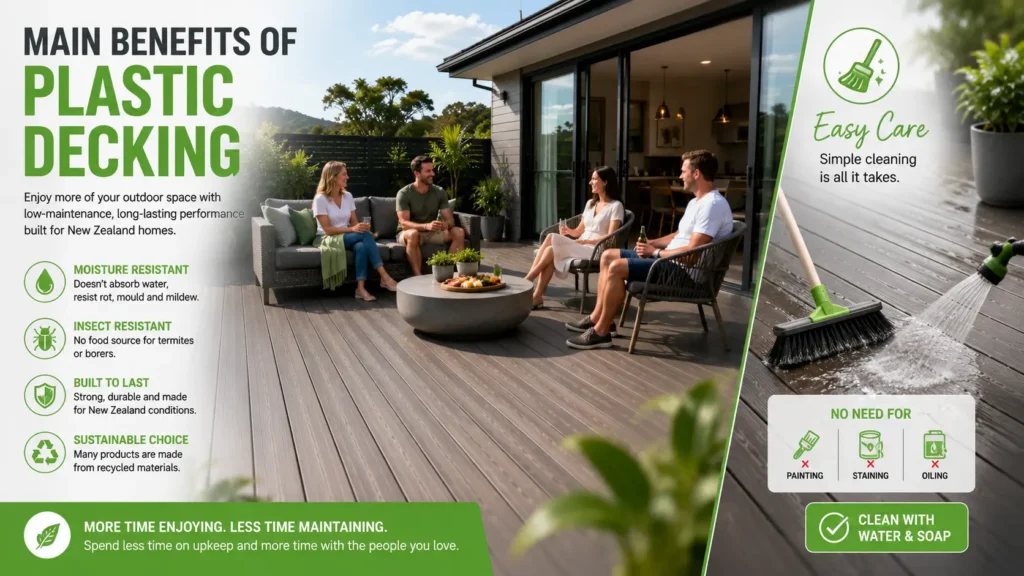
Plastic decking has become a popular choice for New Zealand homeowners who want an outdoor living space that is easy to maintain and built to handle changing weather conditions. While every decking material has its strengths and limitations, plastic decking offers several practical advantages that appeal to homeowners looking for a long-term solution. Understanding these benefits can help you decide whether it is the right material for your project and whether it aligns with your budget, lifestyle, and maintenance expectations.
Low Maintenance Requirements
One of the biggest reasons homeowners choose plastic decking is that it requires far less ongoing maintenance than traditional timber decking. Timber decks need regular care to protect them from moisture, sunlight, and general wear, while plastic decking is designed to maintain its appearance with much less effort.
Unlike timber, plastic decking does not need routine staining, oiling, or painting to protect the surface. This means you can spend more time enjoying your outdoor space instead of maintaining it throughout the year. For busy households or holiday homes that may sit unused for long periods, this reduced maintenance can be a significant advantage.
Cleaning is usually straightforward and can often be completed with basic household equipment. Sweeping away leaves and dirt helps prevent debris from building up, while occasional washing with water and a manufacturer-approved cleaner removes surface grime and keeps the deck looking tidy. Always follow the cleaning recommendations provided by the manufacturer, as different products may have specific care requirements.
Lower maintenance does not mean maintenance-free. Regular inspections are still worthwhile to ensure drainage remains clear, fixings stay secure, and the deck continues to perform as intended.
Some of the practical maintenance advantages include:
- No Surface Treatments: There is generally no need for ongoing staining, sealing, or painting to protect the boards.
- Simple Cleaning: Most dirt and everyday marks can be removed with sweeping and occasional washing.
- Reduced Labour: Less maintenance means fewer weekends spent sanding, recoating, or repairing weather-damaged boards.
- Consistent Appearance: Quality products are designed to retain their finish without the frequent upkeep associated with natural timber.
Resistance To Rot And Insects
Moisture is one of the biggest causes of deterioration in traditional timber decking. When timber repeatedly absorbs rainwater or humidity, it can begin to swell, crack, split, or rot over time if it is not properly protected.
Plastic decking performs differently because the boards do not absorb moisture in the same way as natural wood. This helps reduce many of the common problems associated with prolonged exposure to wet conditions, making plastic decking particularly suitable for many New Zealand environments where rainfall and humidity are common.
Because the material does not provide the same food source as timber, plastic decking is also resistant to damage from termites and many other wood-boring insects. This removes one of the ongoing concerns that can affect untreated or ageing timber decks.
It is important to remember that while the decking boards themselves resist moisture, the supporting subframe may still require regular inspection if it is constructed from timber. Proper drainage, ventilation, and installation remain essential for the overall performance of the deck.
Some key durability benefits include:
- Moisture Resistance: Plastic boards do not absorb water like natural timber, helping reduce swelling and deterioration.
- Rot Resistance: The boards are not susceptible to fungal decay that commonly affects untreated timber.
- Reduced Splitting: Plastic decking is less likely to split or crack due to moisture cycling.
- Insect Resistance: Plastic boards are not vulnerable to termites or many insects that attack wood products.
Long Service Life
Many homeowners consider plastic decking because they want a decking material that continues performing well for many years with relatively little maintenance. While no decking material lasts forever, quality plastic decking products are designed to provide long-term durability when installed and maintained correctly.
Actual performance depends on several factors, including product quality, installation standards, local climate, deck design, drainage, and ongoing care. A premium product installed according to the manufacturer’s specifications will often perform more consistently than a lower-quality alternative that has been incorrectly installed.
Installation plays a major role in long-term performance. Proper joist spacing, suitable ventilation beneath the deck, correct expansion gaps, and approved fixing systems all help the boards perform as intended as temperatures change throughout the year. Skipping these installation requirements may reduce the overall lifespan of the decking and could even affect warranty coverage.
When comparing products, it is worth reviewing the manufacturer’s warranty, technical specifications, and independent testing rather than relying solely on marketing claims. A longer warranty can provide additional confidence, but homeowners should also understand what is covered and any conditions that apply.
When assessing durability, consider the following:
- Product Quality: Higher-quality boards often include improved UV protection, colour stability, and manufacturing consistency.
- Professional Installation: Correct installation helps reduce movement, uneven wear, and long-term performance issues.
- Climate Exposure: Coastal conditions, direct sunlight, and heavy use may influence how the deck performs over time.
- Warranty Coverage: Reviewing warranty terms provides a better understanding of the manufacturer’s confidence in the product.
Recycled Material Options
Many plastic decking products are manufactured using recycled plastic, helping reduce the demand for new raw materials and giving waste plastics another useful purpose. For homeowners who want to reduce their environmental impact, this can be an attractive feature when comparing decking options.
While recycled content is an important consideration, it should not be the only factor used when evaluating sustainability. The overall environmental impact of a decking product also depends on manufacturing methods, transportation, expected service life, maintenance requirements, recyclability at the end of its life, and how often replacement is likely to be needed.
A decking board that contains recycled material but requires frequent replacement may offer fewer long-term environmental benefits than a durable product that remains in service for many years. Looking at the complete lifecycle provides a more balanced assessment than focusing only on the percentage of recycled content.
Before making a purchase, ask suppliers about the origin of recycled materials, manufacturing standards, warranty support, and whether the product can be recycled again when it eventually reaches the end of its usable life.
When comparing environmentally conscious products, consider:
- Recycled Content: Some boards are manufactured using recycled plastics that would otherwise become landfill waste.
- Product Lifespan: Longer-lasting materials may reduce the need for future replacement.
- Maintenance Requirements: Products requiring fewer chemicals and treatments may have a lower ongoing environmental impact.
- End-Of-Life Recycling: Check whether the decking material can be recycled once it has reached the end of its service life.
- Manufacturer Practices: Look for suppliers that provide transparent information about sourcing, manufacturing, and environmental commitments.
Choosing plastic decking is about balancing maintenance, durability, appearance, cost, and environmental considerations. By comparing product quality, installation requirements, warranty coverage, and long-term ownership costs, you can make a more informed decision that suits both your property and the way you plan to use your outdoor space.
Potential Disadvantages Of Plastic Decking
Plastic decking offers many benefits, including low maintenance and strong resistance to moisture, but it is not the right choice for every project. Like any decking material, it has limitations that should be considered before making a decision. Understanding these potential drawbacks helps you compare products more confidently and choose a decking solution that matches your budget, expectations, and the conditions around your home.
Higher Upfront Cost
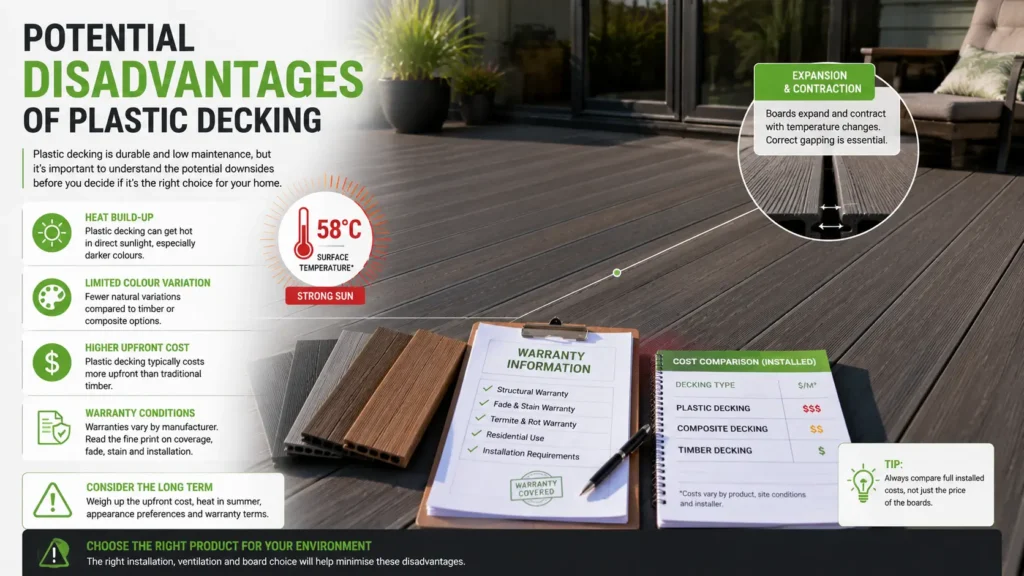
One of the biggest considerations for many homeowners is the initial purchase price. Plastic decking generally costs more than common treated timber decking, particularly when choosing higher-quality products with longer warranties and premium finishes. The material itself is often more expensive, and some systems also require specialised clips or fixing methods that can increase installation costs.
While the upfront investment is higher, it is important to consider the total cost of ownership rather than focusing only on the purchase price. Timber decks often require ongoing staining, oiling, sanding, or replacing damaged boards over the years. Plastic decking typically avoids many of these maintenance expenses, which may help offset the higher initial cost over time.
Several factors influence the overall project cost.
- Deck size: Larger decks require more materials, labour, and subframe components.
- Installation method: Hidden fixing systems and specialised fasteners may add to the overall price.
- Site conditions: Difficult access, sloping land, or extensive ground preparation can increase labour costs.
- Board quality: Premium products often include improved UV protection, stronger construction, and longer warranty periods.
Comparing complete project costs rather than material prices alone provides a more accurate picture of long-term value.
Heat Underfoot
Plastic decking can become noticeably warmer than timber when exposed to direct sunlight, especially during hot summer afternoons. Dark-coloured boards tend to absorb more heat, making the surface less comfortable for bare feet in exposed outdoor areas.
The amount of heat retained depends on several factors, not just the material itself.
- Board colour: Dark grey, charcoal, and black boards generally absorb more heat than lighter colours.
- Surface texture: Some textured finishes help reduce direct surface contact with your feet, although they do not eliminate heat build-up.
- Deck ventilation: Good airflow beneath the deck can help reduce heat retention by allowing warm air to circulate.
- Shade: Trees, pergolas, shade sails, and nearby buildings can significantly reduce surface temperatures throughout the day.
- Deck orientation: North-facing decks usually receive more direct sunlight than shaded or south-facing outdoor areas.
If heat is a concern, ask suppliers whether they have tested surface temperatures under conditions similar to your local climate. Viewing sample boards outdoors during sunny weather also provides a better indication of how different colours perform.
Expansion And Movement
Unlike timber, plastic decking expands and contracts more noticeably as temperatures change. This natural process, known as thermal expansion, occurs because plastic materials respond to heat and cold by changing size slightly throughout the year.
For this reason, correct installation is essential. Manufacturers provide detailed guidelines that specify expansion gaps, fixing systems, and joist spacing to allow the boards to move naturally without causing problems.
Important installation considerations include:
- Expansion gaps: Boards require sufficient spacing at their ends and sides to allow seasonal movement.
- Fixing systems: Many products use hidden clips or specialised fasteners that hold boards securely while still allowing controlled movement.
- Joist layout: Following the recommended joist spacing helps prevent excessive flexing and maintains structural support.
- Installer experience: Contractors familiar with plastic decking systems are more likely to follow manufacturer requirements and avoid common installation mistakes.
Poor installation can result in boards lifting, buckling, or placing unnecessary stress on the fixing system. Choosing an experienced installer and following the manufacturer’s specifications are key steps in achieving a durable deck.
Less Natural Appearance
Although modern plastic decking has improved considerably, some homeowners still prefer the appearance of natural timber. Plastic boards often have consistent colours and repeating grain patterns that may not fully replicate the unique variations found in real wood.
This does not necessarily mean plastic decking looks unrealistic. Many premium products feature embossed textures and carefully designed finishes that create an attractive outdoor space. Personal preference often plays a significant role when comparing materials.
Before making a final decision, it is worth viewing physical samples outside rather than relying solely on brochure images or online photographs. Natural daylight provides a much more accurate representation of colour, texture, and surface finish.
When comparing samples, consider:
- Colour consistency: Check how the colour appears under different lighting conditions.
- Surface texture: Feel the board to understand how closely it resembles timber.
- Grain pattern: Look for realistic embossing rather than repetitive patterns.
- Surrounding materials: Compare the board against your home’s exterior colours, landscaping, fencing, and outdoor furniture.
Taking samples home allows you to see how they complement your property before committing to a full installation.
Product Quality Can Vary
Not all plastic decking products offer the same level of performance. Significant differences can exist between entry-level boards and premium systems, even when they appear similar at first glance.
Lower-priced products may use different manufacturing processes, lower-grade materials, or reduced UV protection, which can affect colour stability, strength, and long-term durability. Premium products often undergo more extensive testing and include improved surface protection, better engineering, and longer warranty coverage.
Before purchasing, compare more than just the advertised price.
- Warranty: Read what is covered, how long the warranty lasts, and any exclusions that may apply.
- Technical data: Review information such as load capacity, slip resistance, UV performance, and installation requirements.
- Product testing: Ask whether the product has been independently tested for durability and weather performance.
- Supplier support: Choose suppliers that provide installation guidance, replacement boards, and ongoing customer assistance.
- Local availability: Confirm that matching boards and accessories will still be available if future repairs or extensions are needed.
Spending time comparing specifications can help prevent disappointment later and provide greater confidence that the product will perform as expected in New Zealand conditions.
Choosing plastic decking involves balancing cost, appearance, maintenance, and long-term performance. By understanding these potential disadvantages before purchasing, you can compare products more effectively, ask informed questions, and select a decking system that best suits your home, lifestyle, and budget.
Types Of Plastic Decking Available In NZ
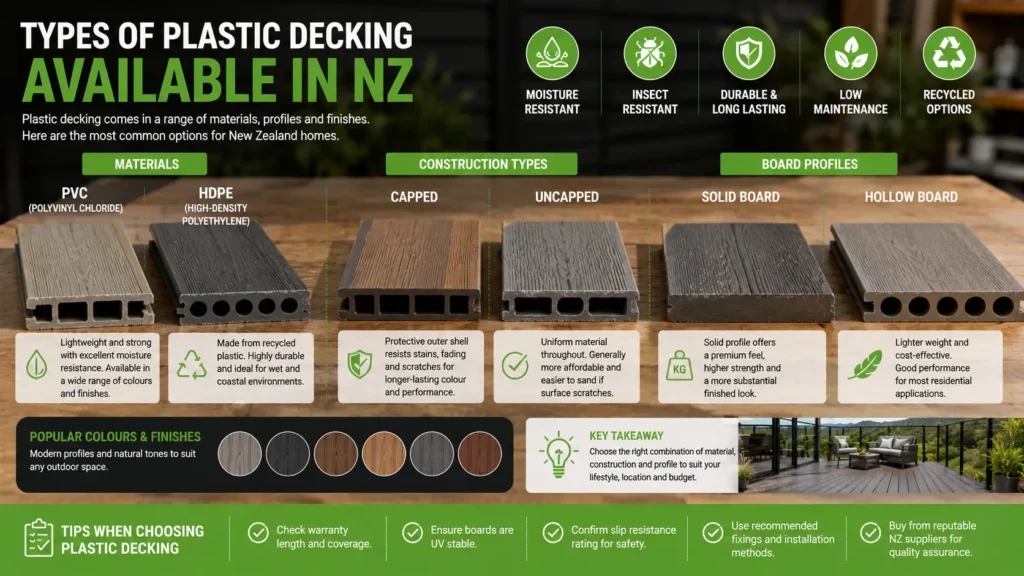
Not all plastic decking products are built the same. Materials, board construction, surface finishes, and manufacturing methods all influence how a deck performs over time. Understanding the different types of plastic decking available in NZ makes it easier to compare products based on durability, maintenance, appearance, and budget instead of relying on marketing claims alone. Before making a decision, it is worth looking beyond the colour or price and considering how each option will perform in your local climate and how the deck will be used.
PVC Decking
PVC decking is one of the most common forms of plastic decking available in New Zealand. These boards are manufactured from polyvinyl chloride, a fully synthetic material that contains no wood fibres. Because the boards do not absorb water, they offer excellent resistance to moisture, making them a popular choice for coastal homes, pool surrounds, and outdoor entertaining areas that experience frequent rain.
One of the biggest advantages of PVC decking is its lightweight construction. Compared with many solid timber boards, PVC boards are generally easier to transport, handle, and install. This can reduce installation time, particularly on larger residential projects where many boards need to be moved around the site.
PVC decking also provides a clean and consistent appearance. Modern manufacturing techniques allow boards to replicate timber grain, although they usually have a more uniform look than natural timber. Many manufacturers offer a wide range of colours and textures to suit contemporary and traditional homes.
From a maintenance perspective, PVC decking requires very little ongoing work. Homeowners generally only need to remove dirt and debris and wash the surface occasionally to keep it looking its best. Unlike timber decking, there is no need for regular sanding, staining, or oiling.
The purchase price of PVC decking is often higher than treated timber. Premium products with advanced UV protection, realistic textures, and extended warranties generally cost more than entry-level options. While the upfront investment may be greater, many homeowners consider the reduced maintenance costs when comparing the long-term value.
HDPE Plastic Decking
HDPE plastic decking is manufactured using high-density polyethylene, which is commonly produced from recycled plastic materials such as milk bottles, detergent containers, and other post-consumer plastics. This gives many HDPE products an environmental advantage by diverting plastic waste from landfill while producing a durable outdoor building material.
HDPE boards are known for their strength and impact resistance. They perform well in environments where moisture, humidity, and heavy outdoor use are common. Since they do not contain timber fibres, they are not vulnerable to rot, insect damage, or fungal decay.
Compared with PVC, HDPE decking often has slightly more flexibility. This characteristic can be beneficial in some applications but also means correct framing, joist spacing, and installation methods become even more important. Following the manufacturer’s installation instructions helps minimise movement and supports long-term performance.
HDPE decking is commonly used for:
- Coastal homes: Excellent resistance to moisture and salt exposure.
- Marinas and waterfront structures: Suitable for damp environments where timber may deteriorate more quickly.
- Public spaces: Durable enough for boardwalks, parks, and recreational areas with regular foot traffic.
- Residential decks: A practical option for homeowners seeking a low-maintenance outdoor living area.
Some HDPE products have a simpler appearance than premium capped boards, while others feature embossed timber textures designed to create a more natural finish. Product quality varies considerably between manufacturers, making it worthwhile to compare warranties, UV protection, and independent performance testing before purchasing.
Solid Versus Hollow Boards
Plastic decking boards are generally available in either solid or hollow profiles. Although both can produce an attractive finished deck, their construction affects strength, weight, installation, and suitable applications.
Solid boards are manufactured with a dense internal structure. As a result, they are usually heavier and offer greater structural rigidity. Many homeowners prefer solid boards because they provide a more substantial feel underfoot and often produce less movement during everyday use.
Hollow boards contain internal chambers that reduce overall weight while using less material. This makes them easier to transport and lift into position during installation. Depending on the product, hollow boards may also be more affordable because they require fewer raw materials.
When comparing the two options, consider the following:
- Weight: Solid boards are heavier, while hollow boards are lighter and easier to handle.
- Strength: Solid boards generally provide greater rigidity and are often preferred for high-traffic areas.
- Installation: Hollow boards frequently use specialised clips and end caps, whereas solid boards may allow a wider range of fixing systems depending on the manufacturer.
- Applications: Solid boards are commonly selected for residential entertaining areas, commercial spaces, and locations where a more substantial feel is preferred. Hollow boards may suit smaller residential decks where reducing weight and material costs is a priority.
The choice should never be based on price alone. Structural requirements, expected foot traffic, framing design, joist spacing, and manufacturer recommendations all influence which board profile is appropriate. A professional installer can help determine whether a solid or hollow board is better suited to your project.
Capped And Uncapped Products
Another important difference between plastic decking products is whether the boards are capped or uncapped.
Capped decking includes a protective outer layer that surrounds the board during manufacturing. This outer shell is designed to improve resistance to stains, scratches, fading, moisture, and everyday wear. Many premium decking products sold in New Zealand use this construction because it helps maintain appearance over time.
Uncapped boards do not have this additional protective layer. While they can still provide good performance, they may be more susceptible to surface staining, colour fading, and weathering depending on the material and environmental conditions.
Some of the key differences include:
- Stain resistance: Capped boards generally offer better protection against food spills, grease, and everyday outdoor stains.
- Fade resistance: The protective layer usually improves UV resistance and helps colours remain more consistent over time.
- Surface texture: Many capped products feature embossed timber grain or textured finishes that improve appearance and grip.
- Maintenance: Both options require routine cleaning, but capped boards often retain their appearance with less effort.
Although capped products usually cost more initially, many homeowners value the additional protection and longer-lasting appearance. When comparing products, it is worth asking what the protective layer covers, whether fading is included in the warranty, and how the manufacturer recommends cleaning and maintaining the boards.
Choosing between capped and uncapped decking should involve more than simply comparing prices. Product quality, expected maintenance, climate conditions, and the level of exposure to sunlight all influence which option provides the best long-term value.
Selecting the right type of plastic decking involves balancing appearance, durability, maintenance, and budget. Understanding how PVC, HDPE, solid and hollow boards, and capped and uncapped products differ allows you to compare decking options with greater confidence and choose a solution that suits both your property and New Zealand’s outdoor conditions.
How Much Does Plastic Decking Cost In NZ?
The cost of plastic decking in New Zealand depends on much more than the price of the decking boards. Material quality, installation requirements, site conditions, and the overall design of the deck all contribute to the final investment. While plastic decking often costs more upfront than many traditional timber options, its lower maintenance requirements can make it a cost-effective choice over time. Understanding what influences pricing will help you compare quotations more accurately and avoid unexpected costs during construction.
Typical Material Cost Factors
Not all plastic decking products are manufactured to the same standard. Differences in materials, construction methods, finishes, and warranties can create significant price variations between products that may appear similar at first glance.
- Board Type: Solid plastic boards generally cost more than hollow boards because they use more material and often provide greater strength and durability. The right option depends on the intended use of the deck and the manufacturer’s structural recommendations.
- Brand: Established brands often invest more in product testing, research, and quality control. While premium brands usually carry a higher price, they may also offer better colour stability, stronger warranties, and improved long-term performance.
- Colour: Lighter and darker colours can vary in price depending on the manufacturer. Some premium colour ranges use specialised pigments that improve UV resistance and help reduce fading over time.
- Finish: Boards with realistic timber-grain textures, embossed finishes, or advanced surface coatings generally cost more than basic smooth boards. These finishes can improve appearance, slip resistance, and scratch resistance.
- Board Profile: Solid boards, hollow-core boards, and different board thicknesses all affect manufacturing costs. Thicker boards may offer greater rigidity, while hollow profiles can reduce weight and material costs.
- Recycled Content: Some products are manufactured using recycled plastic, while others use virgin materials or a combination of both. Manufacturing methods, recycled material quality, and environmental certifications may influence pricing.
- Warranty: Products with longer or more comprehensive warranties often reflect greater confidence in the material’s durability. It is important to compare what each warranty actually covers, including fading, staining, structural performance, and manufacturing defects.
- Imported Versus Locally Supplied Products: Imported decking products may offer competitive pricing, but shipping costs, exchange rates, and product availability can affect the final price. Locally supplied products may provide faster delivery, easier access to replacement boards, and better after-sales support if issues arise.
Installation Cost Factors
Installation often represents a significant portion of the overall project cost. Even when two decks use the same plastic decking boards, differences in site conditions and design complexity can result in noticeably different quotations.
- Deck Size: Larger decks require more materials, labour, and fixings. Although larger projects may reduce the average installation cost per square metre, the total project cost will naturally increase.
- Site Access: Easy access allows installers to move materials and equipment efficiently. Narrow pathways, steep slopes, or restricted access may increase labour time and require smaller equipment or additional manual handling.
- Ground Preparation: Uneven ground, drainage improvements, excavation, or additional foundation work can add to the installation cost before the decking frame is even constructed.
- Framing Condition: If an existing frame can be safely reused, overall costs may be lower. If the subframe is damaged, out of level, or no longer complies with current installation requirements, replacement may be necessary.
- Stairs: Deck stairs require additional framing, cutting, fixings, and finishing work. More complex stair designs naturally require more labour and materials.
- Edging: Picture-frame borders, fascia boards, concealed edges, and decorative finishing details improve the finished appearance but also increase both material and installation costs.
- Curves: Curved deck designs require additional planning, specialised cutting, and more installation time than simple rectangular layouts.
- Balustrades: Glass, aluminium, timber, or cable balustrades add both material and labour costs. The type of balustrade selected can significantly affect the overall project budget.
- Removal Of An Old Deck: Replacing an existing deck may involve demolition, disposal of old materials, and repairs to the underlying structure before new installation can begin. These additional tasks should be clearly listed within the quotation.
Whole-Of-Life Cost
The initial purchase price only tells part of the story. A more useful way to compare decking materials is to consider the total cost of ownership throughout the deck’s lifespan.
Traditional timber decks often require regular cleaning, staining, oiling, sanding, and occasional board replacement to maintain their appearance and structural condition. These maintenance tasks involve both material costs and ongoing labour, whether completed by the homeowner or a contractor.
Plastic decking generally reduces many of these ongoing maintenance requirements. Routine cleaning is usually sufficient to keep the surface looking presentable, eliminating the need for repeated staining or painting. For many homeowners, this lower maintenance commitment is one of the biggest advantages of choosing plastic decking.
It is also important to compare expected durability rather than focusing only on the purchase price. Lower-priced boards may have shorter warranties, lower UV resistance, reduced colour stability, or fewer protective surface features. A premium product may cost more initially but could provide better long-term value through improved performance, reduced maintenance, and a longer service life.
When comparing quotations, consider the complete project rather than the board price alone. A detailed quotation should clearly outline materials, framing, installation, site preparation, demolition, waste removal, warranties, and any optional upgrades. Comparing the total scope of work helps ensure you are making an informed decision instead of simply selecting the lowest initial price.
Choosing plastic decking should be viewed as a long-term investment rather than a short-term purchase. By considering both upfront expenses and ongoing ownership costs, you can select a decking solution that suits your budget while delivering reliable performance and lower maintenance for many years.

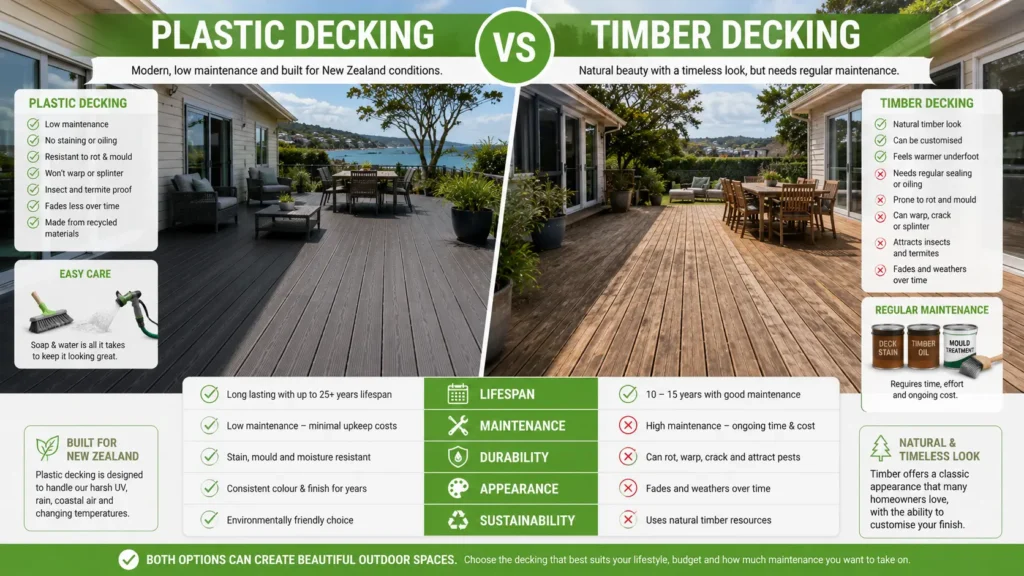
Plastic Decking Versus Timber Decking
Choosing between plastic decking and timber decking is one of the biggest decisions homeowners face when planning a new outdoor living area. Both materials can create an attractive, functional deck, but they differ in maintenance, appearance, durability, cost, and long-term value. The right option depends on how you use your outdoor space, how much maintenance you are willing to do, your budget, and the style of your home. Understanding these differences before making a decision can help you choose a decking material that continues to perform well for many years.
Maintenance
Maintenance is often one of the biggest reasons homeowners choose plastic decking over traditional timber. While both materials benefit from regular cleaning, timber generally requires more ongoing care to maintain its appearance and protect it from weather exposure.
Plastic decking usually only needs routine sweeping to remove leaves and dirt, along with occasional washing using water and a manufacturer-approved cleaning product. Because it does not absorb moisture like timber, it does not require regular staining, painting, or oiling.
Timber decking needs more attention throughout its lifespan. Exposure to sunlight, rain, and changing temperatures gradually breaks down protective finishes, meaning the deck should be cleaned and re-coated periodically to help prevent weathering and moisture damage.
Maintenance requirements commonly include:
- Cleaning: Both plastic and timber decking should be cleaned regularly to remove dirt, mould, leaves, and debris that can make the surface slippery.
- Staining: Timber usually requires periodic staining to restore colour and provide protection against weather exposure, while plastic decking does not require staining.
- Oiling: Many timber species benefit from regular oiling to reduce drying, cracking, and moisture absorption. Plastic decking does not need oil treatments.
- Sanding: Timber surfaces may occasionally require sanding to remove splinters, stains, or weathered areas. Plastic decking should not require sanding under normal use.
- Repairs: Individual timber boards can often be repaired or refinished if damaged. Plastic decking boards are generally replaced rather than repaired when significant damage occurs.
For homeowners looking for a lower-maintenance outdoor space, plastic decking is often the more convenient option. Those who enjoy maintaining natural timber may appreciate the ability to restore and refinish a timber deck over time.
Appearance
Appearance is largely a matter of personal preference, and both materials offer different visual benefits.
Timber decking is valued for its natural grain, colour variation, and unique character. Every board is slightly different, giving the finished deck a more organic appearance that many homeowners prefer, particularly on traditional homes or properties with established gardens.
Plastic decking provides a more uniform finish. Modern manufacturing techniques allow many products to replicate timber grain, but the colour and texture remain more consistent across every board. This consistency can create a clean, contemporary look that suits modern architectural styles.
When comparing appearance, consider:
- Natural grain: Timber offers genuine grain patterns and natural colour variation that cannot be perfectly replicated.
- Consistent finish: Plastic decking provides a uniform colour and texture across the entire deck.
- Colour options: Plastic decking is available in a wide range of manufactured colours, while timber colours depend on the species selected and any applied finishes.
- Weathering: Untreated timber gradually changes colour as it ages, whereas plastic decking is designed to maintain a more consistent appearance over time, although some products may experience gradual colour changes.
Viewing full-size samples outdoors is one of the best ways to compare materials, as colours and textures can look quite different under natural sunlight than they do in a showroom.
Durability
Durability is another important factor, particularly in New Zealand’s varied climate where decks are exposed to rain, strong sunlight, coastal air, and seasonal temperature changes.
Plastic decking is designed to resist moisture, making it less susceptible to problems such as rot, insect damage, and fungal decay. Because it does not absorb water like timber, it is generally more stable in damp environments.
Timber remains a durable material when properly maintained, but its long-term performance depends on the timber species, installation quality, drainage, ventilation, and regular maintenance.
Some of the main durability differences include:
- Moisture resistance: Plastic decking resists water absorption, making it suitable for wet and coastal environments.
- Rot resistance: Plastic boards do not rot, while untreated or poorly maintained timber can deteriorate over time.
- Splitting: Timber may split or crack as it naturally expands and contracts with changing moisture levels. Plastic decking is less likely to split but still expands and contracts with temperature changes.
- Fading: Both materials may experience gradual colour changes from prolonged UV exposure, although premium products often include improved UV protection.
- Movement: Plastic decking expands and contracts more noticeably with temperature, making correct installation gaps essential. Timber movement is generally driven by changes in moisture content.
Regardless of the material chosen, proper installation plays a significant role in long-term performance. Correct joist spacing, adequate ventilation, and effective drainage help maximise the lifespan of both plastic and timber decks.
Cost
Comparing decking costs involves much more than the purchase price of the boards. The overall cost of ownership includes installation, maintenance, repairs, and the expected lifespan of the deck.
Timber decking often has a lower upfront material cost, particularly when using commonly available treated pine. Premium hardwoods can cost considerably more, but many homeowners choose timber because the initial investment is lower than some plastic decking products.
Plastic decking generally requires a larger upfront investment. Premium boards, specialised fixing systems, and manufacturer-specific installation requirements can increase the initial project cost. However, lower maintenance requirements may reduce ongoing ownership costs over time.
When comparing costs, consider:
- Initial materials: Timber products often have lower starting prices than premium plastic decking.
- Installation: Labour costs vary depending on deck size, complexity, framing, and the chosen fixing system.
- Maintenance costs: Timber typically requires ongoing spending on cleaning products, stains, oils, and occasional repairs, while plastic decking usually requires only routine cleaning.
- Replacement costs: Product lifespan, warranty coverage, and maintenance history all influence long-term replacement expenses.
- Long-term value: Looking beyond the initial quote helps provide a more realistic comparison of total ownership costs over many years.
The lowest quote does not always represent the best long-term value. Considering maintenance, expected lifespan, and future repair costs often leads to a more informed decision.
Best Use Cases
There is no single decking material that suits every project. The best option depends on the property’s design, local climate, budget, and how the outdoor area will be used.
Timber decking may be the better choice when:
- Natural appearance: You want authentic timber grain and traditional character.
- Heritage homes: The property has an architectural style that suits natural materials.
- Lower upfront budget: Keeping the initial project cost as low as possible is a priority.
- Refinishing flexibility: You prefer a deck that can be sanded, stained, and restored over time.
Plastic decking may be the better choice when:
- Low maintenance: You want to minimize ongoing maintenance and avoid regular staining or oiling.
- Coastal locations: The property experiences high moisture levels or salt-air exposure.
- Rental properties: Reduced maintenance can lower long-term ownership costs.
- Busy households: You prefer a durable outdoor surface that requires only occasional cleaning.
- Contemporary homes: A consistent finish complements modern architectural styles.
If you are still deciding between timber and plastic decking, ask your contractor to provide samples of each material and explain the maintenance, warranty, and expected lifespan. Comparing these factors alongside your budget and lifestyle often makes the decision much easier.
Choosing between plastic decking and timber is about finding the material that best matches your property’s needs and your long-term expectations. By comparing maintenance, appearance, durability, costs, and everyday use, you can make a well-informed decision that provides lasting value and creates an outdoor space you will enjoy for years to come.
Plastic Decking Versus Composite Decking
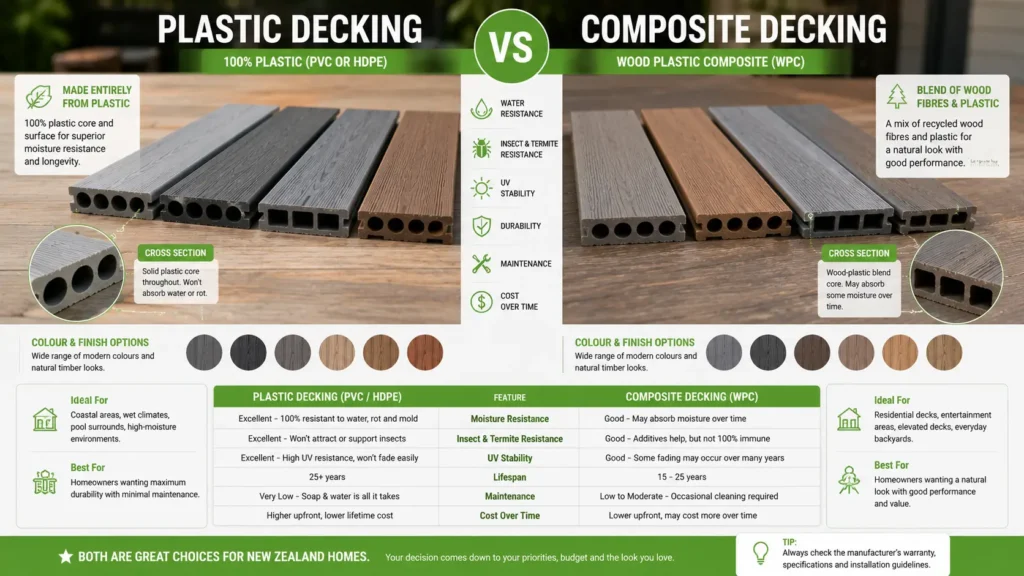
Plastic decking and composite decking are often grouped together because they are both marketed as low-maintenance alternatives to traditional timber. While they share some similarities, they are made from different materials and offer different levels of durability, appearance, maintenance, and performance. Understanding these differences can help you choose a decking material that suits your budget, lifestyle, and the conditions around your home.
Material Composition
The biggest difference between plastic decking and composite decking is what each board is made from.
Plastic decking is manufactured almost entirely from synthetic materials such as PVC or high-density polyethylene (HDPE). Some products use recycled plastics, while others use virgin plastic to achieve greater consistency and performance. Because these boards contain little or no organic material, they do not absorb water in the same way timber products do.
Composite decking combines plastic with wood fibres, sawdust, or other natural materials. The plastic helps protect the board from moisture, while the timber content provides a more natural appearance and feel. The exact blend varies between manufacturers, which means not all composite boards perform the same.
When comparing products, look beyond the marketing description and ask about the board’s actual composition. Two products labelled as “composite decking” may have very different percentages of wood fibre and plastic, which can affect their durability, maintenance requirements, and lifespan.
Feel And Appearance
Many homeowners choose their decking based on appearance, and this is one area where plastic and composite decking can differ noticeably.
Composite decking is generally designed to replicate the look of natural timber. Many premium products feature embossed wood-grain textures, varied colour tones, and matte finishes that closely resemble hardwood decking. This makes composite decking a popular choice for homeowners who want a traditional timber look without the ongoing maintenance.
Plastic decking usually has a more consistent colour and surface finish. Although modern manufacturing has improved its appearance, some products may still look more uniform than composite or natural timber. Depending on the manufacturer, plastic decking may have a smoother or lightly textured finish.
The way the boards feel underfoot can also vary.
- Texture: Composite decking often has deeper grain patterns that create a timber-like feel, while plastic decking may have a smoother or more uniform surface.
- Stiffness: Composite boards are often slightly stiffer because of their wood content, while some plastic boards may feel more flexible depending on their design and profile.
- Finish: Premium products in both categories are available with low-gloss finishes that reduce the artificial appearance often associated with earlier generations of decking.
- Visual realism: Composite decking generally offers a wider range of colours, grain patterns, and natural-looking finishes that closely resemble real timber.
Whenever possible, view full-size samples outdoors in natural daylight. Colours and textures often look different outside than they do under showroom lighting.
Maintenance And Durability
One of the biggest reasons homeowners consider plastic or composite decking is to reduce maintenance compared with traditional timber.
Plastic decking is highly resistant to moisture because it contains little or no organic material. It will not rot, splinter, or become a food source for insects. This makes it a practical option for coastal properties, pool areas, and locations that experience frequent rainfall.
Composite decking also offers excellent durability, but its performance depends on the quality of the product and how it is manufactured. Premium capped composite boards include a protective outer layer that improves resistance to stains, moisture, fading, and everyday wear.
Both materials benefit from routine cleaning to remove dirt, leaves, and organic debris. Regular maintenance helps preserve their appearance and prevents mould or mildew from developing on surface contaminants.
When comparing products, consider the following performance factors.
- Moisture resistance: Plastic decking generally offers excellent protection against water absorption, while high-quality capped composite decking also performs well in wet conditions.
- Stain resistance: Premium products with protective surface layers are usually easier to clean after spills from food, drinks, or outdoor cooking.
- Fade resistance: UV-resistant coatings help slow colour fading, although some gradual weathering is normal over time.
- Cleaning requirements: Most plastic and composite decks only require sweeping and occasional washing with water and a manufacturer-approved cleaner.
Installation quality also plays an important role in durability. Correct joist spacing, drainage, ventilation, and expansion gaps all contribute to long-term performance regardless of which material you choose.
Price And Product Range
Plastic decking and composite decking are available across a wide range of price points, making it important to compare more than just the purchase price.
Plastic decking is often available in fewer design variations, although this depends on the supplier. Composite decking usually offers a broader selection of colours, board widths, surface finishes, hidden fixing systems, and warranty options. This gives homeowners greater flexibility when matching the deck to the style of their property.
The cheapest product is not always the best long-term investment. Lower-priced boards may have shorter warranties, fewer colour options, reduced UV protection, or lower structural performance.
Rather than relying on marketing labels such as “premium” or “high performance,” compare the technical specifications provided by the manufacturer.
Look for information such as:
- Board construction: Whether the board is solid, hollow, capped, or uncapped.
- Slip resistance: Independent slip-test ratings for wet and dry conditions.
- Warranty coverage: What is covered, how long the warranty lasts, and any exclusions.
- Load capacity: Structural performance and recommended joist spacing.
- UV performance: Independent testing for colour stability and fade resistance.
- Installation system: Recommended fixings, expansion requirements, and ventilation guidelines.
- Local support: Availability of replacement boards, technical advice, and warranty assistance within New Zealand.
Comparing technical information rather than product labels gives you a much clearer picture of how each decking option is likely to perform over time.
Choosing between plastic decking and composite decking comes down to more than appearance or price alone. By comparing the materials, long-term maintenance, technical specifications, and suitability for your property, you can select a decking solution that delivers lasting value and performs well in New Zealand’s varied climate.
Where Does Plastic Decking Work Best?
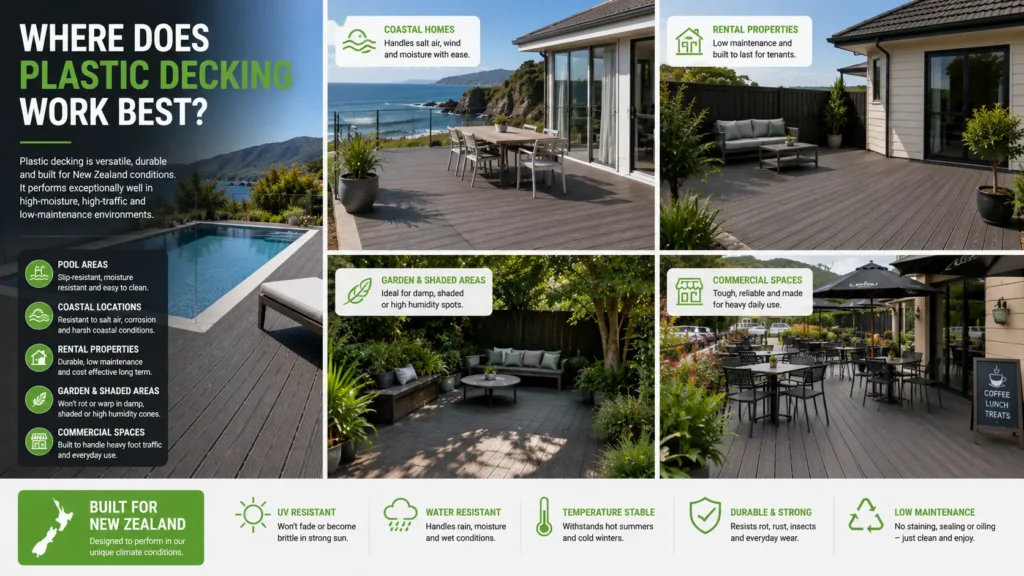
Plastic decking is a practical choice for many outdoor spaces, but its performance depends on how and where it will be used. Factors such as moisture levels, foot traffic, sun exposure, and environmental conditions all influence whether plastic decking is the right option for a particular project. Understanding the strengths and limitations of the material helps homeowners and property owners choose a decking solution that delivers reliable performance and long-term value.
Pool And Spa Areas
Pool and spa areas are among the most common places where plastic decking is installed because these environments are regularly exposed to water, humidity, and splashing. Unlike traditional timber, plastic decking does not absorb moisture, making it resistant to rot, swelling, and many of the problems associated with repeated wet and dry cycles.
Safety should always be part of the decision-making process. While many plastic decking products feature textured surfaces that improve grip, slip resistance varies between manufacturers. It is important to review the product’s tested slip rating rather than assuming all boards perform the same in wet conditions.
Proper drainage also plays a major role in the long-term performance of any deck surrounding a pool or spa. Standing water should be able to drain away efficiently to reduce dirt build-up and minimise the risk of slippery surfaces caused by algae or mould.
Surface temperature is another consideration. Dark-coloured boards exposed to direct sunlight can become noticeably warmer than lighter colours. If the deck will be used barefoot during summer, comparing colour options and viewing product samples outdoors can help you choose a more comfortable finish.
Some practical considerations include:
- Slip resistance: Choose products with independently tested slip ratings suitable for wet environments.
- Drainage design: Ensure the deck is built with adequate falls and water drainage to prevent pooling.
- Board colour: Lighter colours generally remain cooler under direct sunlight than darker finishes.
- Routine cleaning: Remove sunscreen residue, leaves, and organic matter to maintain traction and appearance.
Coastal Properties
Coastal homes place additional demands on outdoor building materials due to salt-laden air, high humidity, and frequent exposure to wind-driven rain. Plastic decking is often considered for these locations because it is not vulnerable to rot or moisture damage in the same way as untreated timber.
Although the decking boards themselves may resist moisture well, the supporting components are equally important. Stainless steel or other corrosion-resistant fixings are commonly recommended for coastal environments to reduce the risk of rust and premature failure.
Not every plastic decking product is designed for every coastal condition. Product quality, UV protection, and manufacturer recommendations should always be reviewed before making a final decision. Choosing a system that has been tested for harsh outdoor conditions provides greater confidence in its long-term performance.
When evaluating products for coastal homes, consider:
- Corrosion-resistant fixings: Select fasteners designed for marine or coastal environments.
- UV performance: Choose products with strong resistance to fading and weathering.
- Warranty coverage: Review whether coastal installations are included within the manufacturer’s warranty.
- Installation system: Follow recommended spacing and fixing methods to allow for normal thermal movement.
Rental Properties
Rental properties often benefit from materials that require minimal ongoing maintenance while continuing to look presentable over many years. Plastic decking appeals to many landlords because it eliminates the need for regular staining, painting, or oiling that timber decks typically require.
Lower maintenance requirements can reduce ongoing property upkeep and simplify routine inspections. Regular sweeping and occasional washing are usually enough to keep the deck clean and functional, provided it has been installed correctly and receives reasonable care.
Durability also makes plastic decking attractive for investment properties where outdoor spaces receive regular use from different occupants. Choosing a quality product with a strong manufacturer’s warranty can help reduce future repair and replacement costs.
Property owners should still remember that no decking material is maintenance-free. Periodic inspections remain important to identify loose fixings, drainage issues, or accidental damage before small problems become larger repairs.
Shaded Or Damp Areas
Gardens surrounded by trees or homes with limited sunlight often experience slower drying times after rain. These damp conditions can accelerate the deterioration of some traditional decking materials, making moisture resistance an important consideration.
Plastic decking does not absorb water like timber, helping reduce the likelihood of rot, splitting, and swelling. This makes it a suitable option for many shaded outdoor spaces where moisture remains present for longer periods.
Good design is still essential. Adequate airflow beneath the deck allows trapped moisture to escape and helps maintain the condition of both the decking boards and the supporting frame. Poor ventilation can encourage mould, mildew, and debris build-up regardless of the decking material.
Regular cleaning also remains necessary. Leaves, dirt, and organic material should be removed to keep drainage paths clear and reduce surface staining.
Helpful maintenance practices include:
- Maintain airflow: Leave sufficient clearance beneath the deck to promote ventilation.
- Keep drainage clear: Remove leaves and debris that may trap moisture.
- Wash periodically: Clean the surface to reduce mould, algae, and dirt build-up.
- Inspect surrounding vegetation: Trim nearby plants where practical to improve sunlight and airflow.
Commercial And High-Traffic Areas
Plastic decking is also used in certain commercial settings where durability and low maintenance are priorities. Outdoor dining areas, boardwalks, apartment developments, schools, childcare centres, and public spaces may all benefit from products designed for frequent use.
Commercial environments usually experience higher foot traffic than residential decks, so selecting a product with suitable load ratings and wear performance is essential. Commercial-grade products are often engineered to handle heavier daily use while maintaining their structural integrity and appearance.
Warranty coverage should also be reviewed carefully, as some manufacturers provide different warranty terms for residential and commercial installations. Installation methods, structural design, and maintenance requirements may also differ depending on the intended use.
Before selecting plastic decking for a commercial project, consider:
- Load ratings: Confirm the product meets the expected structural requirements.
- Wear resistance: Review testing information for heavy foot traffic applications.
- Compliance: Ensure the decking system complies with applicable New Zealand building requirements and manufacturer specifications.
- Commercial warranty: Verify that warranty coverage applies to the intended commercial use.
Choosing the right plastic decking is not simply about selecting a material that looks good. Matching the product to the property’s environment, expected usage, and maintenance expectations helps create an outdoor space that performs well for many years while reducing unnecessary repairs and ongoing upkeep.
What To Check Before Buying Plastic Decking
Choosing plastic decking involves more than comparing colours and prices. The quality of the product, the strength of the warranty, and the level of local support can all influence how well your deck performs over time. Taking the time to review these details before making a purchase can help you avoid unexpected costs, installation problems, and disappointment after the deck has been built. A careful comparison also makes it easier to choose a product that suits New Zealand’s climate and your property’s specific conditions.
Warranty Terms
A warranty can provide valuable peace of mind, but not all warranties offer the same level of protection. Before buying plastic decking, read the warranty carefully instead of relying on the advertised warranty period alone. A longer warranty does not automatically mean better coverage if important issues are excluded.
Pay close attention to what the manufacturer actually guarantees. Some warranties only cover manufacturing defects, while others may also include protection against structural failure, excessive fading, or staining under normal residential use.
Review the exclusions just as carefully as the coverage. Common exclusions may include incorrect installation, poor ventilation beneath the deck, inadequate drainage, commercial use, or failure to follow the manufacturer’s maintenance instructions. Understanding these limitations can prevent disputes if a problem occurs later.
When comparing products, consider asking the supplier:
- Structural Coverage: What defects or failures are covered during the warranty period?
- Colour Protection: Does the warranty include protection against excessive fading or colour changes?
- Stain Protection: Are common household stains covered, and under what conditions?
- Installation Requirements: Does the warranty remain valid only when installed according to the manufacturer’s specifications?
- Claim Process: How are warranty claims handled, and who is responsible for replacement materials or labour?
A reputable supplier should be willing to explain the warranty in plain language and provide supporting documentation before you commit to a purchase.
Slip Resistance
Slip resistance is an important safety consideration, particularly for outdoor decks that are regularly exposed to rain or moisture. While many plastic decking products feature textured surfaces designed to improve grip, their performance can vary significantly between manufacturers.
Rather than relying on appearance alone, ask whether the decking has been independently tested for slip resistance. Product testing provides a more reliable indication of how the surface performs under different conditions than marketing claims alone.
Slip resistance becomes even more important in areas where water is frequently present, including:
- Pool Surrounds: Constant splashing can leave the deck wet throughout the day.
- Spa Areas: Steam and water increase the likelihood of slippery surfaces.
- Outdoor Stairs: Good traction reduces the risk of slips while moving between levels.
- Access Ramps: Extra grip helps improve safety for people of all ages.
- Shaded Areas: Damp conditions can persist longer where sunlight is limited.
Surface texture should also be considered alongside maintenance. Dirt, leaves, moss, or algae can reduce traction over time if the deck is not cleaned regularly. Even the most slip-resistant decking performs best when kept clean.
UV And Fade Resistance
New Zealand’s high UV levels can place significant demands on outdoor building materials. Plastic decking that performs well in cooler climates may react differently when exposed to long periods of strong sunlight, making UV resistance an important factor to investigate.
Ask the supplier whether the product has undergone independent UV testing and request information about expected colour changes over time. Many manufacturers publish technical data showing how their products perform after prolonged exposure to sunlight.
It is also worth comparing different board colours before making a final decision.
Light-coloured boards generally absorb less heat and may show fading differently over time. Dark-coloured boards often provide a bold appearance but may become warmer under direct sunlight and can make gradual colour changes more noticeable.
When evaluating colour options, consider:
- Sun Exposure: Decks facing north or receiving full-day sun may experience greater UV exposure.
- Outdoor Living Habits: Areas used barefoot may benefit from lighter board colours.
- Home Design: Choose colours that complement the surrounding architecture and landscaping.
- Long-Term Appearance: Ask whether colour changes are expected during the first few months of weathering.
Viewing full-size samples outdoors instead of relying on printed brochures provides a much more accurate representation of how the decking will look after installation.
Structural And Installation Requirements
Even premium plastic decking products can underperform if they are installed incorrectly. Every manufacturer provides installation guidelines that are designed to account for the way plastic expands, contracts, and carries weight.
Before purchasing, confirm that the product suits your planned deck design and framing system. Small differences in installation requirements can affect both performance and warranty coverage.
Some of the most important items to review include:
- Joist Spacing: Different products require different support spacing to prevent excessive movement or sagging.
- Fixing Systems: Confirm whether hidden fasteners, clips, or face fixings are recommended.
- Expansion Gaps: Plastic decking expands and contracts with temperature changes, making correct spacing essential.
- Ventilation Requirements: Adequate airflow beneath the deck helps manage moisture and supports long-term performance.
- Framing Compatibility: Check whether the boards are approved for timber, steel, or aluminium framing systems.
If you are hiring a contractor, ask whether they have previous experience installing the specific product you are considering. Familiarity with the manufacturer’s installation system can reduce the likelihood of mistakes and help ensure the finished deck performs as intended.
Local Product Support
Reliable local support can become just as important as the product itself, particularly if replacement boards or technical assistance are needed in the future.
Before selecting a decking brand, find out whether it has an established distribution network within New Zealand. Imported products with limited local availability may become difficult to match if additional boards are required several years after installation.
Questions worth asking include:
- Stock Availability: Are boards regularly stocked within New Zealand?
- Replacement Boards: Can matching boards be supplied if repairs become necessary?
- Technical Assistance: Is local product support available if installation questions arise?
- Installer Network: Are there approved installers familiar with the product?
- After-Sales Service: Who should you contact if warranty or product issues occur?
Choosing a supplier with dependable local support can save considerable time and frustration if unexpected issues arise during or after construction.
Samples And Completed Projects
Photographs and online catalogues can provide useful inspiration, but they rarely show how plastic decking looks and feels in real-world conditions. Whenever possible, inspect physical samples before making your final decision.
View samples outdoors in natural daylight rather than under showroom lighting. Natural light provides a more accurate impression of colour, texture, and surface finish throughout the day.
If possible, visit a completed project where the decking has already been installed. Walking across the deck allows you to experience characteristics that cannot be judged from photographs alone.
Pay attention to:
- Colour: Observe how the boards appear in both sunlight and shade.
- Texture: Feel the surface underfoot and assess overall comfort.
- Heat: Notice how warm the decking becomes after sun exposure.
- Movement: Walk across the deck to check for excessive flex or noise.
- Finish Quality: Examine board alignment, joints, and overall workmanship.
Speaking with homeowners or installers who have used the product can also provide practical insights into long-term performance, maintenance, and overall satisfaction that are difficult to find in marketing material.
Choosing plastic decking is a long-term investment, so taking the time to compare warranties, safety features, installation requirements, local support, and real-world examples can help you make a more informed decision. Looking beyond appearance and price alone gives you a better chance of selecting a decking product that performs well, remains attractive, and suits your home for many years.
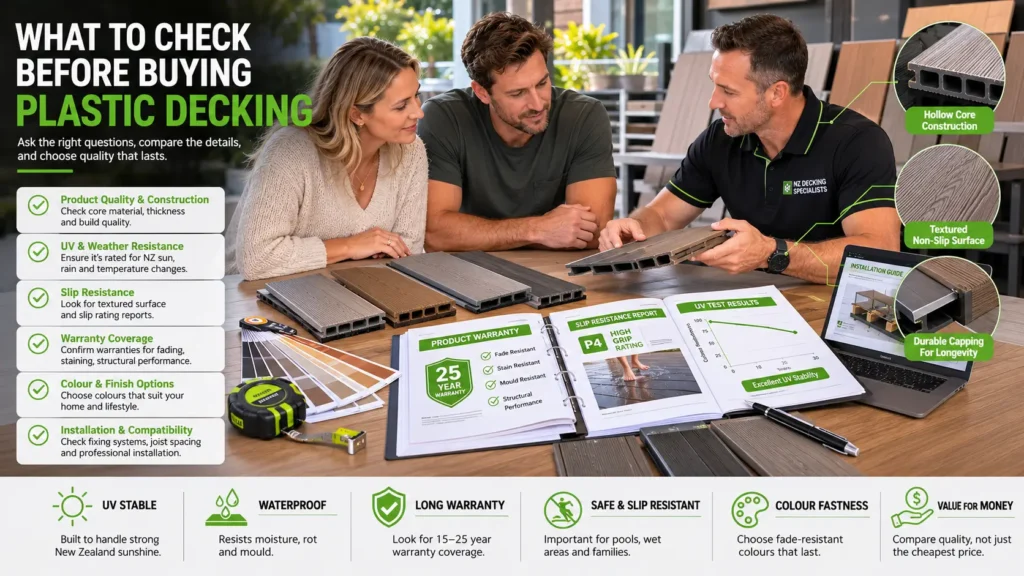
Plastic Decking Installation Considerations
Installing plastic decking involves more than choosing attractive boards. The quality of the finished deck depends heavily on how well the supporting structure is built and whether the manufacturer’s installation instructions are followed. A properly installed deck is more likely to remain level, stable, and durable for many years, while poor installation can lead to movement, uneven boards, drainage problems, and reduced product lifespan. Understanding the key installation considerations before work begins can help you avoid costly mistakes and achieve a better long-term result.
Subframe Preparation
The subframe forms the structural foundation of any deck. Even the highest-quality plastic decking boards cannot perform properly if they are installed on an unstable or poorly constructed frame. A strong, level, and well-drained subframe helps distribute loads evenly, supports the decking boards correctly, and reduces unnecessary movement over time.
Before installation begins, the site should be prepared to provide a stable base. The ground beneath the deck should drain freely so water does not pool around the supporting structure. Any uneven areas should be corrected before framing starts, as small inaccuracies at this stage often become much more noticeable once the decking boards are installed.
Several framing materials are commonly used in New Zealand, each with its own advantages.
- Treated timber framing: A popular choice for residential decks because it is widely available, cost-effective, and compatible with most plastic decking systems.
- Steel framing: Offers excellent structural strength, dimensional stability, and resistance to twisting or shrinking. It is often selected for larger decks or projects requiring longer spans.
- Aluminium framing: Lightweight, corrosion-resistant, and well suited to coastal environments where moisture and salt exposure are ongoing concerns. Aluminium also remains dimensionally stable as temperatures change.
Regardless of the framing material selected, the joist spacing should always match the decking manufacturer’s recommendations. Plastic decking boards vary in thickness and structural performance, so using incorrect spacing can result in excessive flexing or movement.
Correct Board Spacing
Plastic decking naturally expands and contracts as temperatures change. This movement is known as thermal movement and is one of the most important factors to consider during installation.
Unlike timber, plastic boards can expand noticeably during hot weather. If adequate expansion gaps are not provided, boards may press against one another, causing buckling, lifting, or distortion. Leaving the correct spacing allows the boards to move naturally without placing unnecessary stress on the deck.
Expansion requirements vary between manufacturers because different products use different materials and manufacturing processes. For this reason, there is no universal spacing measurement that applies to every plastic decking system.
Common spacing requirements may include:
- Board-end gaps: Allow room for lengthwise expansion.
- Side gaps: Maintain airflow and accommodate width movement.
- Perimeter clearances: Prevent boards from pressing against walls, posts, or fixed structures.
- Joist alignment: Ensure fixing clips and fasteners perform correctly throughout the deck.
Always follow the installation guide supplied with the specific product being used. These recommendations are based on product testing and help ensure the deck performs as intended throughout changing seasons.
Fixings And Fasteners
The fixing system plays an important role in both the appearance and long-term performance of plastic decking. Choosing the correct fasteners helps keep boards secure while allowing the natural expansion and contraction required by the material.
Many modern plastic decking products use hidden fixing systems rather than exposed screws. Hidden clips fit between the boards, creating a cleaner appearance while maintaining consistent board spacing across the deck surface. This approach also eliminates visible screw heads, giving the finished deck a more refined look.
Some products may still require face fixing in specific areas such as perimeter boards, stair nosings, or feature sections. Where visible screws are necessary, manufacturers often recommend colour-matched fasteners for a more discreet finish.
Properties located near the coast require additional consideration when selecting fasteners.
- Stainless steel fasteners: Help resist corrosion caused by salt-laden air and coastal moisture.
- Marine-grade fixings: May be recommended for homes located very close to the ocean.
- Manufacturer-approved clips: Ensure compatibility with the decking system and help maintain warranty coverage.
- Compatible materials: Prevent unwanted reactions between different metals that could shorten the life of the fasteners.
Using incorrect screws or substitute fixing systems may affect both the structural performance of the deck and the manufacturer’s warranty.
Ventilation And Drainage
Good airflow beneath the deck is just as important as the visible decking surface. While plastic decking itself resists moisture, the supporting frame and surrounding ground still benefit from proper ventilation and drainage.
Allowing air to circulate beneath the deck helps reduce trapped moisture, limits condensation, and supports the long-term condition of the framing system. Poor ventilation can create damp conditions that may shorten the lifespan of timber subframes and encourage mould growth around the surrounding area.
Effective drainage is equally important. Rainwater should be able to flow away freely rather than collecting beneath the deck.
Key drainage considerations include:
- Ground clearance: Maintain adequate space beneath the deck to encourage airflow and allow future maintenance access.
- Surface drainage: Direct water away from the house and supporting structure.
- Deck fall: Slight falls may be required to encourage water runoff where recommended by the manufacturer.
- Site grading: Ensure surrounding ground levels do not trap water beneath the deck.
- Drainage paths: Keep drainage channels free from debris to prevent water build-up.
Careful planning during installation helps protect both the deck and the supporting structure from unnecessary moisture-related issues.
Professional Installation Versus DIY
Some homeowners with construction experience may successfully install plastic decking themselves, particularly on smaller and less complex projects. However, installing plastic decking requires more than basic carpentry skills.
The installer must understand structural framing, manufacturer-specific fixing systems, expansion requirements, drainage, ventilation, and accurate setting out. Small installation errors may not be obvious immediately but can affect the appearance and performance of the deck over time.
Professional installers typically have access to specialised tools and experience that help achieve a more accurate result.
Examples include:
- Laser levels: Ensure the deck remains level across the entire structure.
- Precision cutting equipment: Produce cleaner joints and more accurate board fitting.
- Manufacturer training: Familiarity with product-specific installation systems.
- Problem-solving experience: Ability to adjust for uneven sites, restricted access, or unusual layouts.
Warranty conditions should also be considered before deciding whether to install the deck yourself. Some manufacturers require their products to be installed according to strict guidelines, while others may recommend or require installation by approved contractors to maintain full warranty protection.
A qualified deck builder is often the safer choice when:
- Large or elevated decks: Structural accuracy becomes more important as complexity increases.
- Sloping sites: Site preparation and framing require greater precision.
- Coastal properties: Corrosion-resistant materials and specialised detailing are needed.
- Complex layouts: Curves, stairs, multiple levels, and integrated lighting increase installation difficulty.
- Warranty protection: Professional installation may help meet manufacturer requirements.
- Building consent or engineering: Larger structures may require compliance with local building regulations.
Although professional installation usually increases the initial project cost, it can reduce the risk of future repairs, improve the finished appearance, and provide greater confidence that the decking system will perform as intended.
Choosing the right installation approach is just as important as selecting the decking material itself. A well-designed subframe, correct spacing, suitable fixings, effective drainage, and careful workmanship all contribute to a deck that remains safe, attractive, and durable for years to come.
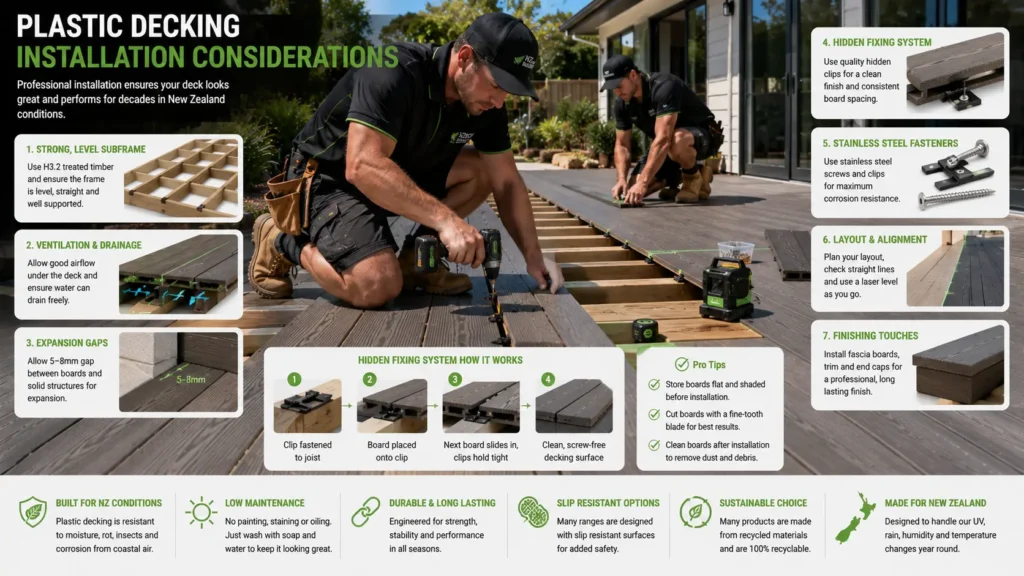
Common Plastic Decking Mistakes To Avoid
Choosing the right plastic decking involves more than comparing colours or finding the lowest quote. Many problems that appear months or even years after installation can often be traced back to decisions made during the planning stage. Understanding the most common mistakes can help you choose a decking system that performs well in New Zealand conditions, reduces future maintenance, and provides better long-term value.
Choosing By Price Alone
A lower purchase price can be appealing, but the cheapest decking boards are not always the most economical choice over the life of the deck. Lower-priced products may use lower-grade materials, offer shorter warranties, or have reduced resistance to fading, scratching, and thermal movement.
When comparing products, look beyond the initial cost.
- Material quality: Higher-quality boards often provide better durability, colour stability, and structural performance.
- Warranty coverage: Longer warranties may indicate greater confidence in the product, but always review the terms carefully.
- Maintenance costs: A slightly more expensive product that requires less maintenance may cost less to own over time.
- Replacement availability: Choosing a well-supported product makes it easier to source matching boards if repairs are needed later.
Rather than asking which product is the cheapest, ask which one offers the best value for your budget and expected lifespan.
Confusing Plastic Decking With Composite Decking
Many homeowners assume plastic decking and composite decking are the same material, but they are manufactured differently and have distinct characteristics.
Plastic decking is generally made from synthetic materials such as PVC or HDPE, while composite decking combines plastic with wood fibres or similar natural materials. These differences affect appearance, maintenance requirements, expansion, weight, and overall performance.
Before purchasing, ask the supplier exactly what the boards are made from and how they are expected to perform in your local environment.
- Material composition: Understand whether the boards are fully plastic or wood-plastic composite.
- Appearance: Composite boards often provide a more natural timber look, while plastic boards usually have a more consistent finish.
- Maintenance: Cleaning methods and long-term care can vary between materials.
- Performance: Moisture resistance, expansion rates, and surface temperatures may differ depending on the product.
Understanding these differences makes it easier to compare products fairly and choose the one that suits your project.
Ignoring Expansion Requirements
Plastic decking naturally expands and contracts as temperatures change. If expansion gaps are not included during installation, boards may push against one another, causing buckling, movement, or unnecessary stress on fixings.
Every manufacturer provides recommended expansion gaps based on board length, installation temperature, and climate. These guidelines should always be followed rather than relying on guesswork.
Proper spacing allows the decking to move naturally without affecting its appearance or structural performance.
Using Incorrect Joist Spacing
Even premium decking boards can feel unstable if the supporting framework is not built correctly. Joist spacing that exceeds the manufacturer’s recommendations can lead to excessive flexing, uneven surfaces, and reduced structural performance.
The required spacing varies depending on the board profile, board thickness, and intended use of the deck.
- Board support: Proper spacing helps distribute weight evenly across the deck.
- Surface stability: Correct framing reduces movement when people walk across the deck.
- Warranty compliance: Many manufacturers require specific joist spacing as part of their warranty conditions.
- Long-term durability: A well-built subframe helps prevent unnecessary stress on the decking boards.
The supporting frame is just as important as the decking boards themselves.
Selecting Dark Boards For Exposed Sunny Areas Without Testing Heat
Dark-coloured decking often creates a modern appearance, but darker surfaces absorb more solar heat than lighter colours. On exposed decks that receive direct afternoon sun, the surface may become uncomfortable to walk on during warmer weather.
Before making a final decision, view full-size samples outdoors rather than relying on showroom lighting or printed brochures.
Consider factors such as:
- Deck orientation: North-facing decks generally receive more sunlight throughout the day.
- Local climate: Hotter regions and sheltered outdoor spaces may experience higher surface temperatures.
- Intended use: Pool areas, children’s play spaces, and barefoot entertaining areas may benefit from lighter colours.
- Shade options: Pergolas, umbrellas, and landscaping can reduce direct sun exposure.
Testing samples under real outdoor conditions provides a much more accurate indication of how the finished deck will perform.
Overlooking Slip Performance
Appearance should never be the only consideration when selecting decking. Slip resistance is especially important in areas that are regularly exposed to water, such as pool surrounds, outdoor entertaining spaces, stairs, and decks in high-rainfall regions.
Many manufacturers provide independently tested slip ratings that help homeowners compare products.
When reviewing slip performance, consider:
- Surface texture: Textured finishes generally provide better grip than smooth surfaces.
- Wet-area suitability: Check whether the product is recommended for frequently wet environments.
- Cleaning requirements: Dirt, algae, and leaves can reduce slip resistance if the deck is not maintained.
- Household needs: Families with children or older adults may benefit from products with higher slip resistance.
Selecting a board with suitable slip performance improves both safety and confidence when using the outdoor space.
Failing To Check Warranty Exclusions
A long warranty may appear reassuring, but not every issue is automatically covered. Many warranties contain exclusions that homeowners only discover after a problem occurs.
Before purchasing, read the warranty documentation carefully and ask questions if any conditions are unclear.
Pay attention to:
- Coverage period: Different components may have different warranty lengths.
- Installation requirements: Incorrect installation may void the warranty.
- Maintenance obligations: Some products require routine cleaning to maintain coverage.
- Excluded damage: Staining, fading, scratches, misuse, or poor ventilation may not be included.
Understanding the warranty before installation helps prevent unexpected surprises later.
Hiring An Installer Without Product-Specific Experience
Plastic decking systems often have unique installation requirements that differ from timber decking. An experienced timber deck builder may still need product-specific knowledge to install certain plastic decking systems correctly.
Ask prospective installers about their previous experience with the exact product you are considering.
Useful questions include:
- Previous projects: How many similar decks have they completed?
- Manufacturer training: Have they completed any approved installation training?
- Project photos: Can they provide examples of completed work?
- Reference clients: Are previous customers willing to provide feedback?
Experienced installation reduces the likelihood of movement, warranty issues, and premature repairs.
Skipping Drainage And Ventilation Planning
Although plastic decking itself resists moisture, the supporting structure beneath it still requires adequate drainage and ventilation.
Poor airflow can allow moisture to remain beneath the deck, affecting the subframe, fasteners, and surrounding materials.
Good planning should include:
- Water runoff: Ensure rainwater can drain away efficiently.
- Air circulation: Allow sufficient airflow beneath the decking boards.
- Ground clearance: Maintain suitable clearance between the deck and the ground.
- Subframe protection: Use framing materials and fixings suitable for the local environment.
A properly ventilated deck generally performs better and requires fewer repairs over time.
Buying A Product Without Reliable Local Supply
Some imported decking products may be difficult to replace if a board becomes damaged years after installation. Colour ranges can change, suppliers may stop importing certain products, and replacement boards may no longer match the original installation.
Before committing to a product, ask about future availability.
- Replacement boards: Confirm whether matching boards can be sourced locally.
- Accessory availability: Check that clips, trims, and fixings will remain available.
- Supplier support: Choose suppliers with an established presence in New Zealand.
- After-sales service: Ask who will assist if warranty or product issues arise.
Reliable local support provides peace of mind and makes future maintenance much easier.
Choosing plastic decking involves balancing appearance, performance, installation quality, and long-term value rather than focusing on a single feature. Taking the time to compare products carefully, understand installation requirements, and work with experienced professionals can help you avoid costly mistakes and enjoy a deck that performs well for many years.
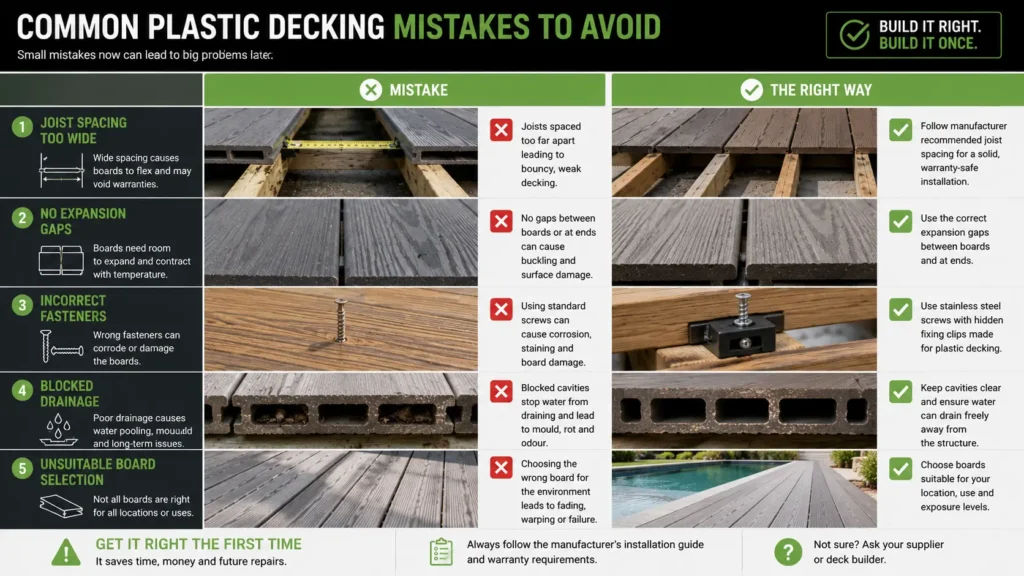
Is Plastic Decking Worth It In NZ?
Plastic decking can be an excellent investment for many New Zealand homeowners, but it is not automatically the best solution for every property. The right choice depends on your budget, maintenance expectations, local climate, how the deck will be used, and the appearance you want to achieve. Comparing plastic decking with timber and composite decking helps you understand where each material performs well and where another option may offer better value.
When Plastic Decking Makes Sense
Plastic decking is often chosen because it offers a combination of durability and low maintenance. For many homeowners, reducing ongoing upkeep is just as important as the initial purchase price.
- Low-maintenance priorities: Plastic decking does not require regular staining, painting, or oiling like traditional timber. Routine maintenance usually involves sweeping away leaves and dirt, followed by occasional washing to remove surface grime. This makes it a practical option for homeowners who want an attractive outdoor area without committing to ongoing maintenance.
- Wet or coastal conditions: Many parts of New Zealand experience frequent rainfall, high humidity, or exposure to salt-laden coastal air. Plastic decking is resistant to moisture, making it less likely to rot, split, or suffer insect damage than many timber products. While the supporting frame still requires proper drainage and ventilation, the decking boards themselves generally cope well with challenging weather conditions.
- Long-term ownership: If you plan to stay in your home for many years, plastic decking may provide better long-term value. Although the initial investment is often higher than some timber options, the reduced maintenance costs and fewer repair requirements can make ownership more economical over time.
- Pool areas: Pool surrounds and spa areas regularly experience water exposure. Plastic decking can be well suited to these environments because it does not absorb moisture like timber. It is still important to choose a product with an appropriate slip rating and follow the manufacturer’s installation recommendations for drainage and spacing.
- Rental or commercial use: Investment properties, cafés, accommodation providers, schools, and commercial buildings often benefit from materials that require minimal ongoing maintenance. Plastic decking can reduce maintenance interruptions while maintaining a clean appearance for tenants, customers, or visitors.
When Another Material May Be Better
Although plastic decking offers many benefits, there are situations where another decking material may better suit your project.
- Strong preference for natural timber: Some homeowners simply prefer the warmth, texture, and unique grain patterns of natural timber. Even premium plastic products are manufactured materials and may not fully replicate the appearance or feel of real wood.
- Limited upfront budget: Plastic decking usually costs more than many treated timber alternatives. If your budget is tight and you are comfortable with regular maintenance, timber may allow you to complete the project at a lower initial cost.
- Heritage-style homes: Traditional villas, character homes, and heritage properties often look more authentic with natural timber decking. Matching the architectural style of the home can sometimes be more important than reducing maintenance requirements.
- Projects where heat retention is a concern: Some plastic decking products, particularly darker colours, can become noticeably warmer in direct sunlight. This may be a consideration for decks that receive full sun throughout the day or are frequently used barefoot. Viewing product samples outdoors can help you compare surface temperatures before making a decision.
- Sites with unsuitable framing or installation constraints: Plastic decking products often require specific joist spacing, fixing systems, expansion gaps, and ventilation. If an existing deck frame does not meet these requirements, modifications may be needed before installation. In some situations, another decking material may better suit the existing structure.
Questions To Ask Before Deciding
Before investing in any decking material, take time to compare products carefully. Asking the right questions can help you avoid unexpected costs and choose a decking system that performs well over the long term.
- What is the full installed cost? Ask for a detailed written quotation that includes materials, framing, demolition of any existing deck, labour, fixings, edging, stairs, balustrades, site preparation, waste removal, and GST where applicable. Comparing complete project costs provides a more accurate picture than comparing board prices alone.
- How hot does the board become? Request product samples and, if possible, inspect completed decks during warm weather. Surface temperature can vary between colours, textures, and manufacturers, so seeing the product in real conditions is often more valuable than relying on marketing claims.
- What does the warranty exclude? Read the warranty carefully rather than focusing only on its length. Check whether it covers fading, staining, structural performance, manufacturing defects, commercial use, coastal installations, and whether professional installation is required to maintain coverage.
- Can replacement boards be sourced locally? Ask whether matching boards and accessories are readily available in New Zealand. This can make future repairs much easier if accidental damage occurs or if additional decking is required later.
- Has the product been used successfully in similar NZ conditions? Look for completed local projects that have been installed for several years. Seeing how the decking has performed in similar weather conditions provides useful insight into colour stability, durability, and long-term appearance.
- Does the installer follow the manufacturer’s system? Every decking product has its own installation requirements. Confirm that the installer follows the manufacturer’s recommendations for framing, expansion gaps, ventilation, fixings, and drainage. Correct installation plays a major role in achieving the expected lifespan and maintaining warranty protection.
Choosing the right decking material is about finding the best balance between appearance, maintenance, durability, and cost. By carefully comparing products, asking practical questions, and considering how the deck will be used over the coming years, you can make a well-informed decision that suits both your property and your lifestyle.
Choosing the right decking material starts with understanding your property, budget, and long-term maintenance needs. Explore our decking options, compare plastic, composite, and timber products, and request expert advice based on your site conditions. Click through to discuss your project and get clear guidance on costs, materials, installation, and the best solution for your outdoor space.
References
- TimberTech New Zealand – Advanced PVC Decking Overview
https://www.timbertech.nz/products/decking-overview/pvc/ - BiForm New Zealand – Composite Decking Boards and Product Information
https://biform.co.nz/products-services/composite-decking-boards/ - Building CodeHub NZ – ModWood Decking and Screening CodeMark Certificate
https://codehub.building.govt.nz/resources/cmnz70070-version-3 - Mitre 10 New Zealand – Decking Buying Guide and Material Comparison
https://www.mitre10.co.nz/shop/garden/landscaping-supplies/decking - Forté – Mineral Decking vs Composite Decking vs Plastic Decking
https://forte.co.nz/articles/mineral-decking-vs-composite-decking-vs-plastic-decking
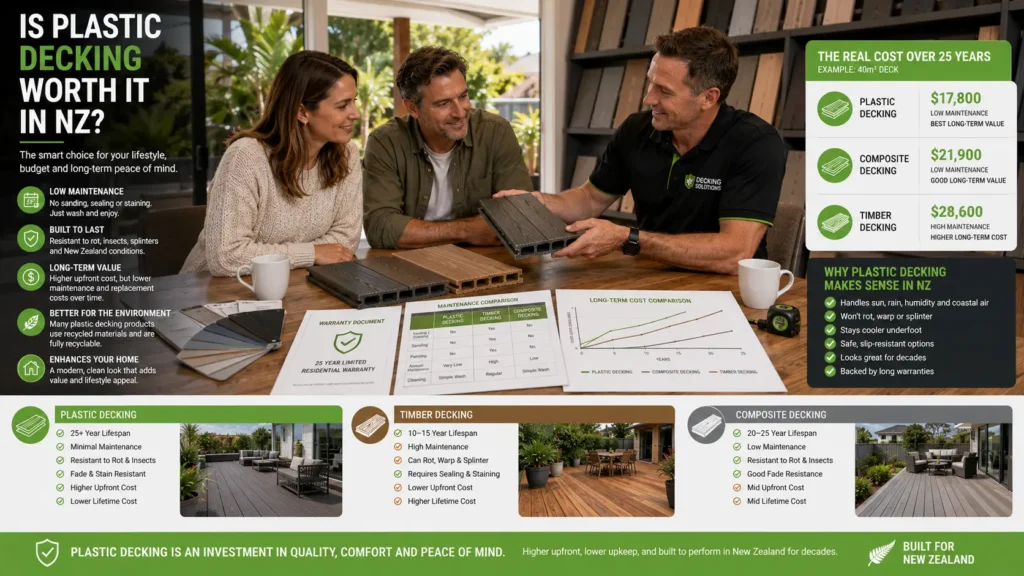
FAQs: About Plastic Decking In NZ
What is plastic decking?
Plastic decking is a decking material made from synthetic plastics such as PVC or HDPE, with some products containing recycled plastic. Unlike timber, it does not absorb moisture, making it resistant to rot, insect damage, and decay. It is commonly chosen for its low maintenance and long service life.
Is plastic decking better than timber decking?
The better option depends on your priorities. Plastic decking generally requires less maintenance and offers better resistance to moisture, while timber provides a more natural appearance and may have a lower upfront cost. Comparing installation costs, maintenance requirements, and the look you want will help determine the best choice.
How much does plastic decking cost in NZ?
The total cost depends on the brand, board type, deck size, framing requirements, site access, and installation complexity. Premium products usually cost more but may offer better warranties, improved fade resistance, and longer-lasting performance. Requesting a detailed quote is the best way to understand the full project cost.
Does plastic decking get hot in the sun?
Yes, plastic decking can become warm under direct sunlight, especially darker coloured boards. Surface temperature varies depending on the product, colour, ventilation, and surrounding conditions. Viewing samples outdoors and discussing heat performance with your supplier can help you make a suitable choice.
Is plastic decking slippery when wet?
Many plastic decking products are designed with textured surfaces to improve grip, but slip resistance varies between manufacturers. If the deck will be used around pools, spas, or exposed outdoor areas, check the product’s tested slip rating before purchasing.
How long does plastic decking last?
A well-manufactured and correctly installed plastic deck can provide many years of reliable service. The actual lifespan depends on product quality, installation standards, climate, and ongoing care. Always review the manufacturer’s warranty and maintenance recommendations.
Can plastic decking be installed as a DIY project?
Some experienced homeowners may be able to install plastic decking themselves, but every product has specific installation requirements. Correct joist spacing, expansion gaps, ventilation, and fixing methods are essential for long-term performance. Professional installation may also be required to maintain warranty coverage.
What maintenance does plastic decking require?
Plastic decking usually only requires regular sweeping and occasional washing with water and a suitable cleaning product. Unlike timber, it does not require staining, painting, or oiling. Periodic inspections of fixings, drainage, and the supporting frame are still recommended.
What is the difference between plastic decking and composite decking?
Plastic decking is made primarily from synthetic plastic materials, while composite decking combines plastic with wood fibres or similar materials. Composite products often provide a more timber-like appearance, whereas plastic decking generally offers higher moisture resistance. Both have different maintenance needs, performance characteristics, and price ranges.
Is plastic decking suitable for New Zealand homes?
Plastic decking can perform well in many New Zealand environments, including coastal and high-rainfall areas, because it resists moisture and rot. Choosing a quality product, following the manufacturer’s installation instructions, and selecting a board suited to your local climate are important for achieving long-term performance.
Conclusion
Plastic decking can be an excellent choice for New Zealand homeowners who want a durable, low-maintenance outdoor surface that performs well in wet and coastal environments, but it is not automatically the best option for every property. While it offers advantages such as resistance to rot, insects, and moisture, it may also have a higher upfront cost, retain more heat in direct sunlight, and provide a different appearance compared with natural timber. The long-term performance of any deck depends on far more than the board material alone. The quality of the product, the supporting subframe, correct installation methods, drainage, ventilation, and the experience of the installer all play an important role in how well the deck performs over time. Before making a decision, take the time to compare product samples in natural daylight, review technical specifications, understand warranty coverage, and request detailed quotations that clearly outline what is included in the total installation cost. Looking beyond the purchase price alone will help you compare the true long-term value of different decking options. Every property has different site conditions, levels of sun exposure, drainage requirements, intended use, and budget considerations, so the most suitable solution should always be based on your specific needs rather than marketing claims or general recommendations.