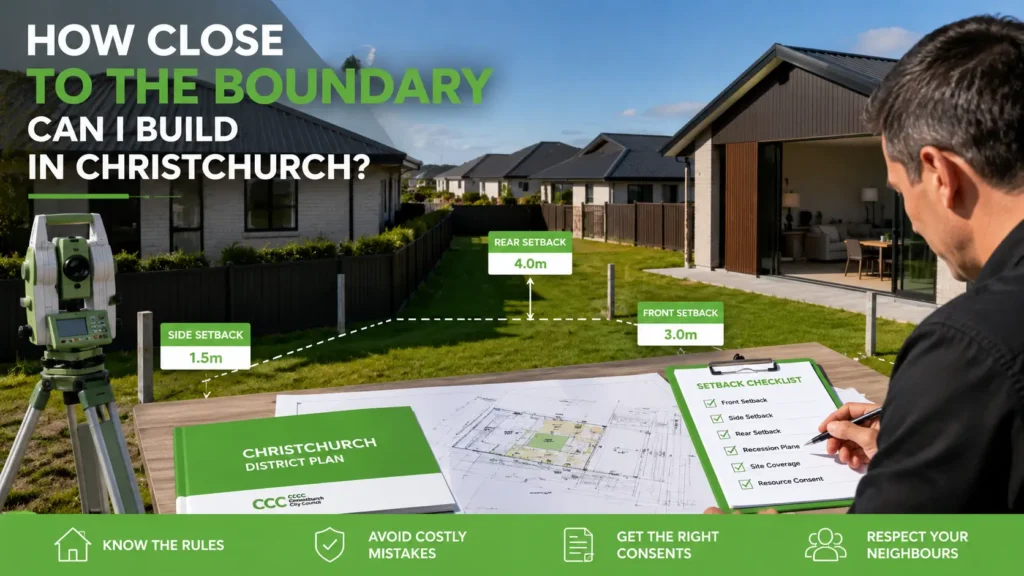
Welcome to our guide on how close to the boundary can I build in Christchurch, where you’ll learn the key rules, setbacks, and planning requirements that can affect your building project. Whether you are planning a new home, garage, shed, sleepout, or extension, understanding boundary restrictions is essential for avoiding costly mistakes, consent issues, and neighbour disputes. Christchurch properties are subject to specific district plan rules that can vary depending on zoning, site layout, building height, and other factors. In this guide, we explain the most important considerations, including setback requirements, recession planes, consent obligations, and practical steps you can take to ensure your project complies with local regulations and moves forward with confidence.
In Christchurch, how close you can build to a boundary depends on your property’s zoning, building height, and Christchurch District Plan rules. Many residential properties require minimum side and rear yard setbacks, while recession plane requirements may also limit building height near boundaries. Always check site-specific rules before starting construction.
Table of Contents
Understanding Building Boundary Setbacks In Christchurch
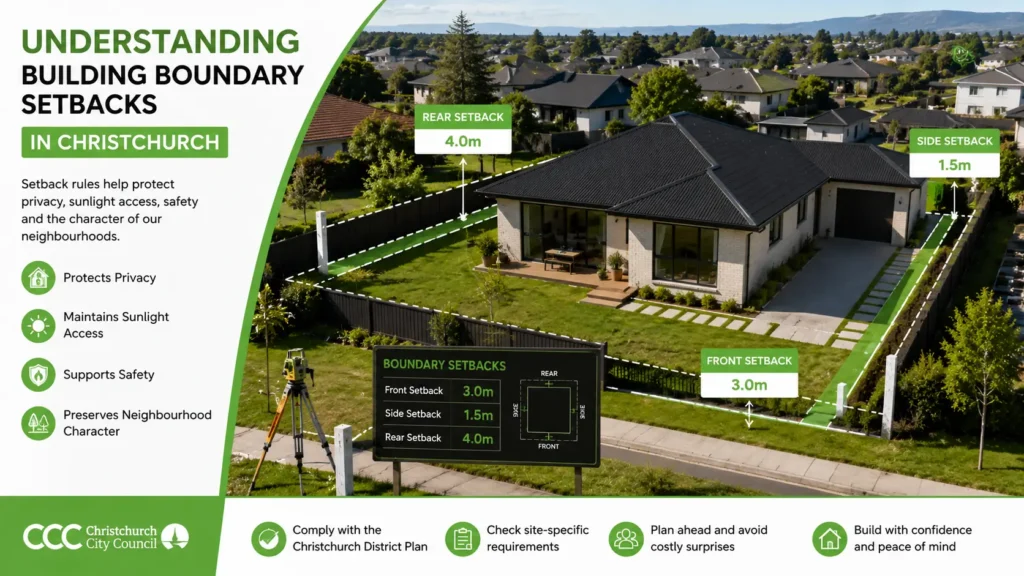
Before starting any building project in Christchurch, it is important to understand how boundary setback rules affect what you can build and where you can place it on your property. Setbacks are a key part of the Christchurch District Plan and help ensure that buildings are positioned in a way that supports privacy, safety, access to sunlight, and the overall character of neighbourhoods. Whether you are planning a new home, a garage, a sleepout, or an extension, understanding setback requirements early can help you avoid costly design changes, consent issues, and disputes with neighbours.
What Is A Boundary Setback?
A boundary setback is the minimum distance a building must be positioned away from a property boundary. These distances are established through planning rules and vary depending on factors such as zoning, building type, and site conditions. Setbacks apply to front, side, and rear boundaries and play an important role in how land is developed throughout Christchurch.
The purpose of setback regulations is to create adequate space between buildings, preserve amenity values, and ensure neighbouring properties are not negatively affected by development. Without setback rules, buildings could be constructed too close together, leading to issues such as overshadowing, reduced privacy, and restricted access.
The relationship between property boundaries, neighbouring sites, and public spaces is a key consideration when applying setback requirements. Councils use these rules to balance private property rights with the wider interests of the community.
Some of the main functions of boundary setbacks include:
- Protecting Privacy: Setbacks help reduce direct overlooking between neighbouring homes and outdoor living areas.
- Maintaining Open Space: Adequate spacing between buildings creates a less crowded environment and supports comfortable living conditions.
- Supporting Access: Setbacks can provide room for maintenance access, drainage systems, and emergency services when required.
- Improving Streetscapes: Front yard setbacks contribute to a consistent appearance along residential streets and public areas.
Why Boundary Setbacks Matter
Boundary setbacks are not simply administrative requirements. They are practical planning tools designed to support the long-term functionality and liveability of residential areas.
One of the most significant benefits of setback regulations is the protection of privacy. When buildings are placed too close to property boundaries, windows, balconies, and outdoor spaces can directly overlook neighbouring properties. Setback rules help minimize these conflicts and create a more comfortable environment for residents.
Access to sunlight and daylight is another major consideration. Christchurch’s planning framework includes provisions that help prevent excessive shading on neighbouring properties. Combined with recession plane requirements, setbacks help ensure that homes retain reasonable access to natural light throughout the year.
Fire safety also plays an important role in setback regulations. Greater separation between buildings can reduce the risk of fire spreading from one structure to another. In some situations, buildings located close to boundaries may require additional fire-rated construction methods to meet Building Code requirements.
Boundary setbacks also support broader urban planning objectives by helping maintain the visual character of established neighbourhoods. Consistent spacing between buildings contributes to attractive streetscapes and preserves the intended design outcomes for different residential zones.
Key reasons setback rules matter include:
- Privacy Protection: Adequate separation helps reduce overlooking and supports peaceful enjoyment of neighbouring properties.
- Natural Light Access: Proper spacing allows sunlight to reach homes, gardens, and outdoor living areas.
- Fire Safety Compliance: Building separation can reduce fire risks and influence construction requirements.
- Neighbourhood Character: Setbacks help maintain the appearance, openness, and visual quality of residential areas.
- Property Functionality: Well-planned setbacks can improve access, landscaping opportunities, and future development options.
Who Needs To Follow Setback Rules?
Boundary setback requirements apply to a wide range of property owners and developers. Many people assume these rules only affect large construction projects, but even relatively small developments may need to comply with setback standards.
Homeowners planning additions such as garages, decks, sleepouts, or home extensions must consider how setback rules affect their project. Failing to check setback requirements before finalising plans can lead to unexpected redesigns and additional approval costs.
Property developers are often required to undertake detailed planning assessments to ensure proposed developments comply with setback standards, recession plane controls, and other district plan requirements. These assessments become particularly important on smaller sites where available building space may be limited.
Renovators should also pay close attention to setback rules when expanding an existing dwelling. While the original structure may have been built under previous regulations, any new work may need to comply with current planning requirements.
Investors planning secondary dwellings, rental units, or redevelopment projects must carefully evaluate setback requirements during the feasibility stage. Early planning can help identify site limitations and avoid delays during the consent process.
The people most commonly affected by setback requirements include:
- Homeowners: Individuals building new structures or extending existing homes.
- Property Developers: Developers planning residential subdivisions, townhouses, or larger housing projects.
- Renovators: Property owners undertaking significant alterations or additions.
- Investors: Investors exploring secondary dwellings, minor residential units, or redevelopment opportunities.
- Design Professionals: Architects, designers, surveyors, and planners responsible for preparing compliant building plans.
Understanding setback requirements before work begins can save considerable time, money, and frustration. A clear understanding of your property’s planning controls provides a stronger foundation for making informed decisions and achieving a smoother approval process.
When planning any construction project near a boundary, taking the time to understand setback requirements can help prevent costly mistakes and improve the likelihood of a successful outcome. By considering these rules early in the planning process, property owners can create designs that comply with Christchurch regulations while maintaining good relationships with neighbours and protecting the long-term value of their property.
How Close Can You Build To A Boundary In Christchurch?
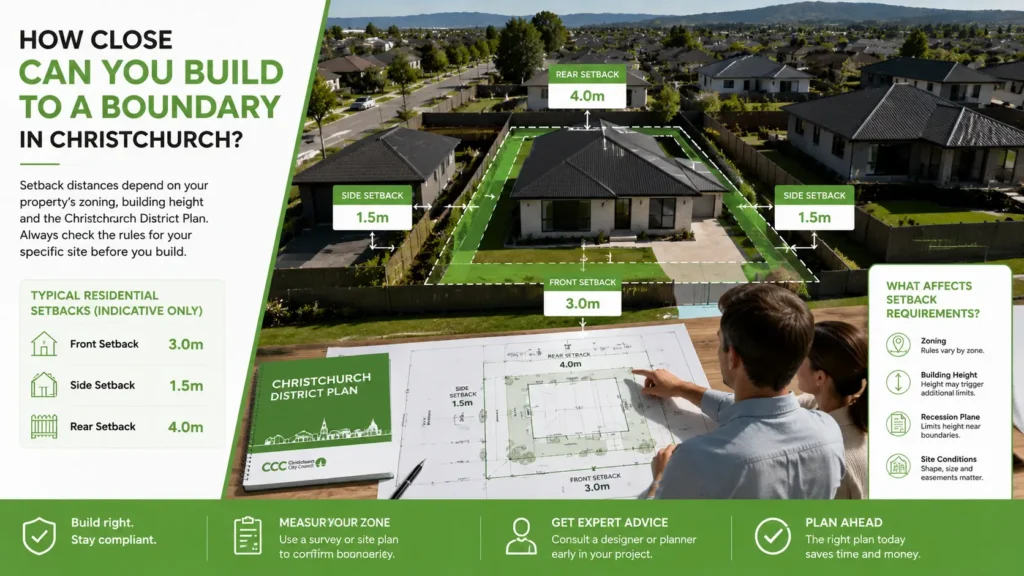
Understanding how close you can build to a boundary in Christchurch is one of the most important steps when planning a new home, extension, garage, shed, or other structure. Boundary setback requirements are designed to balance development opportunities with the needs of neighbouring properties. These rules help maintain privacy, access to sunlight, safety, and the overall character of residential areas. While many properties follow standard setback requirements, the exact rules can vary depending on zoning, site characteristics, and the type of building being proposed.
Standard Residential Setback Requirements
Most residential properties in Christchurch are subject to setback requirements that determine how far buildings must be positioned from property boundaries. These rules are established through the Christchurch District Plan and are intended to create well-designed neighbourhoods that provide adequate space between buildings.
General Setback Rules For Residential Properties
Setbacks create separation between buildings and property boundaries. They help ensure homes have access to natural light, outdoor living space, and sufficient room for maintenance and emergency access.
Some of the key reasons setbacks exist include:
- Neighbour Protection: Helps reduce overshadowing and protects privacy between adjoining properties.
- Safety Considerations: Creates space for maintenance, drainage, and emergency access when required.
- Neighbourhood Character: Supports a consistent streetscape and prevents overcrowding on residential sites.
- Property Functionality: Allows room for landscaping, pathways, and outdoor living areas.
While setback requirements may seem restrictive, they often help property owners avoid future disputes and create more functional sites.
Front Boundary Setbacks
Front boundary setbacks regulate how close a building can be positioned to the street. These setbacks contribute to the visual appearance of a neighbourhood and help maintain a consistent building line along residential roads.
Front setbacks often influence:
- Street Appeal: Creates a balanced appearance throughout the neighbourhood.
- Pedestrian Safety: Provides separation between private property and public spaces.
- Landscaping Opportunities: Allows room for gardens, driveways, and entrance features.
- Traffic Visibility: Improves sightlines for vehicles entering and exiting properties.
For many residential developments, the front setback is one of the first planning requirements assessed during the design process.
Side Boundary Setbacks
Side boundary setbacks control how close buildings can be constructed to neighbouring properties on either side of a site. These setbacks are especially important for maintaining privacy and reducing the visual impact of larger structures.
Side setbacks can affect:
- Building Design: Room layouts may need adjustment to comply with setback requirements.
- Window Placement: Privacy considerations often influence where windows can be located.
- Future Maintenance: Adequate access is needed for exterior repairs and upkeep.
- Neighbour Relationships: Compliance helps minimise disputes over building placement.
For projects involving garages, extensions, or additional dwellings, side setbacks are often a critical design consideration.
Rear Boundary Setbacks
Rear setbacks provide space between buildings and the back boundary of a property. These areas often contribute to private outdoor living spaces and help preserve sunlight access for neighbouring sites.
Rear setbacks can influence:
- Outdoor Living Areas: Provides usable backyard space for recreation and landscaping.
- Neighbouring Properties: Reduces the impact of large structures on adjoining sections.
- Drainage Planning: Allows space for stormwater management and site services.
- Future Improvements: Preserves flexibility for later additions or site enhancements.
Property owners should review rear setback requirements early in the planning process to avoid costly redesigns.
How Zoning Can Affect Boundary Distances
Zoning plays a significant role in determining how close a building can be positioned to a boundary. Different zones have different objectives, which means setback requirements can vary considerably across Christchurch.
Residential Suburban Zones
Residential suburban zones are generally designed to accommodate traditional low-density housing. These areas typically prioritise privacy, open space, and neighbourhood character.
In these zones, setback requirements often aim to:
- Maintain Spacious Sites: Preserve separation between neighbouring homes.
- Protect Sunlight Access: Reduce excessive shading of adjoining properties.
- Support Residential Amenity: Promote comfortable and functional living environments.
- Preserve Streetscape Consistency: Encourage a cohesive appearance throughout the area.
Homeowners in suburban zones should carefully review setback and recession plane requirements before finalising building plans.
Medium-Density Residential Zones
Medium-density residential zones are intended to support more efficient land use while still providing quality living environments. These areas may allow buildings to be positioned closer to boundaries than traditional suburban developments.
Common characteristics include:
- Higher Housing Capacity: Supports additional dwellings within established urban areas.
- Smaller Site Sizes: Often results in reduced setbacks compared to suburban zones.
- Urban Development Goals: Encourages more housing near services and transport links.
- Design-Based Compliance: Greater emphasis on managing privacy and visual effects through design.
Projects in medium-density areas often require careful planning to balance development potential with compliance requirements.
Residential Intensification Areas
Residential intensification areas support increased housing density and are often associated with ongoing urban growth strategies. These locations may have different setback provisions designed to accommodate more compact development.
Factors commonly considered include:
- Housing Supply Objectives: Supports additional residential development within existing urban areas.
- Efficient Land Use: Allows more intensive use of residential sections.
- Transport Accessibility: Often located near key transport routes and community facilities.
- Urban Growth Planning: Aligns with broader development goals for Christchurch.
Because regulations in these areas can differ significantly, obtaining project-specific advice is often worthwhile.
Rural Residential Zones
Rural residential zones generally provide larger lot sizes and a more open environment. While these properties may appear less restricted, setback requirements still apply and can vary based on site characteristics.
These zones often focus on:
- Protecting Rural Character: Preserving open space and visual amenity.
- Managing Land Use Effects: Reducing impacts on neighbouring properties and rural activities.
- Environmental Considerations: Addressing natural features and site constraints.
- Long-Term Land Management: Supporting sustainable development patterns.
Larger sections may offer greater flexibility, but planning requirements should still be confirmed before building.
Situations Where Different Rules May Apply
While standard setback rules apply to many properties, certain site conditions can create additional requirements or exceptions. Understanding these situations early can help prevent delays and unexpected costs.
Corner Sites
Corner sites often have more than one street-facing boundary, which can create additional setback requirements. Because these properties are visible from multiple roads, councils frequently apply special design considerations.
Potential impacts include:
- Additional Frontage Controls: More than one boundary may be treated as a front yard.
- Visibility Requirements: Clear sightlines may be needed for traffic safety.
- Design Constraints: Building placement options may be more limited.
- Landscaping Expectations: Streetscape presentation can be an important consideration.
Corner sites often benefit from professional planning advice before detailed design work begins.
Irregular-Shaped Sections
Not all properties have straightforward rectangular boundaries. Irregular-shaped sections can create unique challenges when measuring setbacks and applying planning rules.
Common issues include:
- Complex Boundary Lines: Setback calculations may require careful interpretation.
- Limited Building Platforms: Usable building space can be reduced.
- Design Adaptations: Building layouts may need to be customized.
- Survey Requirements: Accurate site information becomes especially important.
A qualified surveyor can help clarify boundary locations and identify potential constraints.
Cross-Lease Properties
Cross-lease properties often involve shared land arrangements that require additional consideration before building work can proceed.
Important factors include:
- Lease Documentation: Existing agreements may affect building rights.
- Owner Approvals: Other leaseholders may need to be consulted.
- Boundary Interpretation: Exclusive-use areas can differ from freehold boundaries.
- Legal Requirements: Additional documentation may be necessary before construction.
Cross-lease developments can be more complex than standard freehold properties, making early professional advice valuable.
Subdivided Lots
Recently subdivided properties may be subject to specific consent conditions or planning requirements that affect boundary setbacks.
Issues commonly encountered include:
- Subdivision Conditions: Previous approvals may impose development restrictions.
- Infrastructure Requirements: Easements and service corridors may limit building locations.
- Minimum Building Areas: Some lots have designated building platforms.
- Ongoing Compliance Obligations: Property owners may need to meet conditions established during subdivision approval.
Reviewing property records and consent documentation can help identify any site-specific restrictions before planning begins.
Understanding how setback requirements interact with zoning, site conditions, and planning controls can save significant time and expense during a building project. Taking the time to confirm the rules that apply to your property before finalising plans can help ensure a smoother approval process and reduce the risk of costly changes later.
The Recession Plane Rule Explained
When planning to build close to a property boundary in Christchurch, one of the most important rules to understand is the recession plane requirement. This rule is designed to balance development rights with the needs of neighbouring property owners by helping preserve access to sunlight and reducing the visual impact of larger structures. Many homeowners discover that meeting setback requirements alone is not enough, as a building must also comply with recession plane standards. Understanding how this rule works early in the planning process can help prevent costly redesigns, consent issues, and delays.
What Is The Recession Plane?
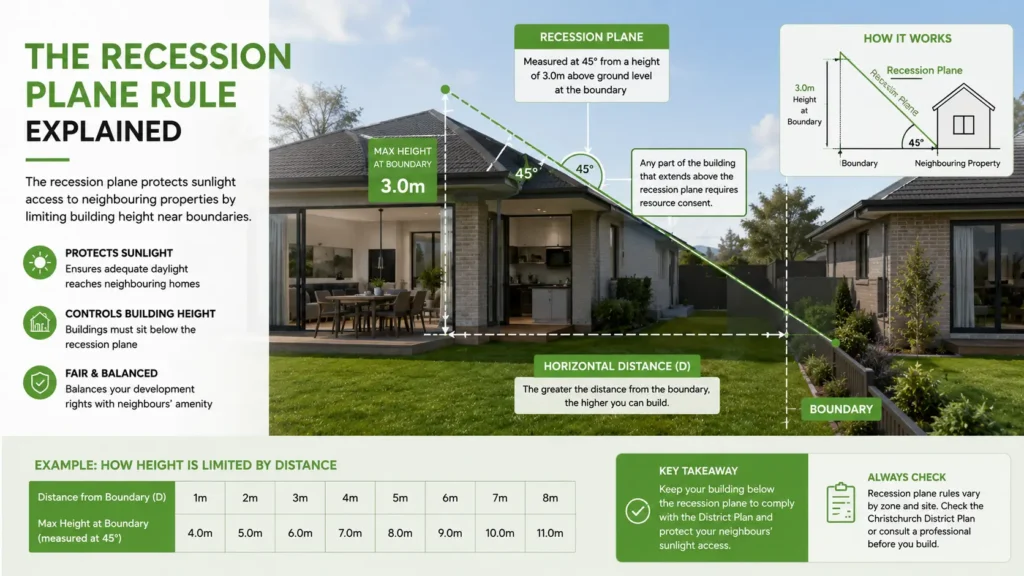
A recession plane is an imaginary angled surface that starts at a property boundary and extends upward across a site. Buildings generally need to fit beneath this plane to comply with Christchurch planning rules. The exact angle and application may vary depending on zoning and specific district plan requirements.
The purpose of the recession plane is to ensure that neighbouring properties continue to receive reasonable access to sunlight, daylight, and open space. Without these controls, taller buildings constructed close to boundaries could create excessive shading and negatively affect nearby homes and outdoor living areas.
For homeowners, the recession plane acts as a design guide that influences the maximum height of a building as it approaches a boundary. It helps maintain a fair balance between development opportunities and neighbourhood amenity.
Some of the key benefits of recession plane rules include:
- Sunlight Protection: Helps reduce excessive shading on neighbouring gardens, decks, and outdoor spaces.
- Neighbourhood Character: Supports a consistent scale of development within residential areas.
- Privacy Considerations: Limits the potential for elevated structures to overlook nearby properties.
- Planning Balance: Allows development while protecting the rights and enjoyment of adjacent landowners.
How Recession Planes Affect Building Height Near Boundaries
The closer a building is positioned to a boundary, the more likely it is to be affected by recession plane restrictions. In practical terms, this means that a structure’s allowable height often decreases as it gets closer to the property line.
For example, a single-storey building may comfortably fit within the recession plane, while a taller two-storey extension in the same location could exceed the permitted envelope. As a result, homeowners frequently need to adjust building designs to ensure compliance.
This relationship between height and setback distance is one of the most common challenges encountered during residential planning. Even when a building meets minimum yard setback requirements, it may still breach the recession plane if the height extends beyond the allowable angle.
Common restrictions homeowners encounter include:
- Second-Storey Limitations: Upper-level additions may require setbacks or design modifications.
- Roof Height Constraints: Roof ridges and gables often need careful planning to remain compliant.
- Boundary Proximity Issues: Taller structures generally require greater separation from boundaries.
- Consent Requirements: Buildings that exceed recession plane limits may require resource consent.
Because recession plane calculations can be technical, many homeowners choose to work with architects, designers, or planning consultants to assess compliance before finalising building plans.
Examples Of Recession Plane Compliance
Understanding real-world examples can make recession plane requirements easier to visualise. Different types of structures are affected in different ways depending on their size, height, and location on the site.
A small garden shed positioned away from the boundary may easily fit within the recession plane and require minimal design consideration. In contrast, a large detached garage with a higher roofline may need design adjustments if it is located close to a neighbouring property.
Home extensions often present the greatest challenge. A proposed second-storey addition may initially exceed the recession plane, requiring the design team to modify the roof shape, reduce wall heights, or increase the distance from the boundary.
Typical design adjustments used to achieve compliance include:
- Lower Roof Profiles: Reducing overall roof height can help keep the building within the permitted envelope.
- Setback Increases: Moving the structure further from the boundary often creates additional allowable height.
- Roof Design Changes: Hip roofs and other lower-profile roof forms may improve compliance outcomes.
- Stepped Building Forms: Adjusting upper levels can reduce the impact on neighbouring properties.
- Reduced Wall Heights: Lowering exterior walls may help maintain compliance without significant redesign.
These adjustments are commonly used during the design phase and can often resolve recession plane issues before consent applications are submitted.
Understanding recession plane requirements early in your project can save time, money, and frustration. By considering building height, boundary proximity, and site-specific planning rules from the beginning, homeowners can develop practical designs that protect neighbouring properties while achieving their own building goals.
Can You Build A Garage, Shed, Or Sleepout Near The Boundary?
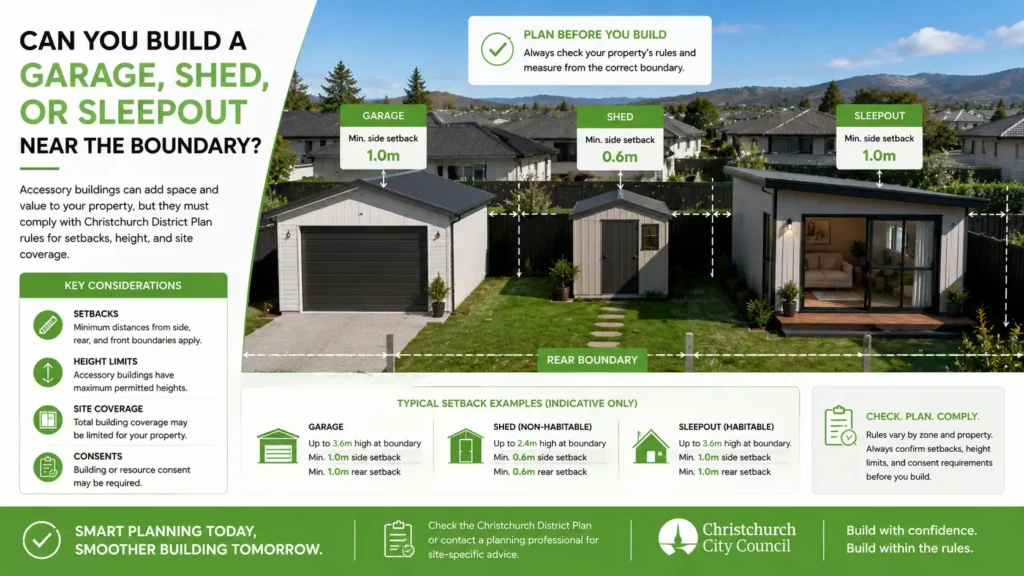
Many Christchurch homeowners want to maximise the use of their section by building a garage, shed, or sleepout close to a property boundary. While these structures are often smaller than a main dwelling, they are still subject to planning and building rules that can affect where they can be located. Factors such as building height, zoning, recession planes, site coverage limits, and consent requirements all play a role in determining what is permitted. Understanding these rules before construction begins can help prevent costly redesigns, approval delays, and disputes with neighbours.
Boundary Rules For Detached Garages
Detached garages are one of the most common structures built near property boundaries. Whether you are adding storage space, protecting vehicles, or creating a workshop, it is important to ensure the garage complies with Christchurch planning requirements.
Height Restrictions
The height of a detached garage can directly affect how close it may be built to a boundary. Taller structures have a greater impact on neighbouring properties and are more likely to be affected by recession plane controls.
- Building Height Limits: Most residential zones have maximum building-height requirements that apply to detached garages as well as houses.
- Recession Plane Compliance: A garage that exceeds the allowable height near a boundary may breach recession plane rules and require design modifications or resource consent.
- Roof Design Impact: The shape and pitch of the roof can influence whether the structure complies with height-related restrictions.
Before finalising plans, it is advisable to check both the permitted height limits and recession plane requirements that apply to your property.
Placement Considerations
The location of a detached garage can affect access, usability, and compliance with local planning rules.
- Boundary Setbacks: Minimum setback distances may apply depending on the property’s zoning and the size of the proposed structure.
- Vehicle Access: The garage should be positioned to allow safe and practical access from the driveway.
- Neighbouring Properties: Placement should minimise shading, privacy impacts, and visual bulk on adjacent sections.
Careful planning at the design stage often makes it easier to meet council requirements while maintaining functionality.
Common Approval Requirements
Many detached garages require some level of approval before construction can begin.
- Building Consent: Larger garages or structures with specific design features may require building consent under New Zealand building regulations.
- Resource Consent: Resource consent may be necessary if the garage does not comply with setback, height, or recession plane requirements.
- Professional Plans: Detailed plans prepared by a qualified designer can help streamline the approval process and reduce compliance issues.
Property owners should confirm approval requirements early to avoid delays once construction is underway.
Building Sheds Near Property Boundaries
Sheds are popular additions for storing tools, gardening equipment, and outdoor supplies. Although many sheds are relatively small, they are not automatically exempt from planning and building rules.
Small Accessory Structures
Small accessory structures generally have fewer restrictions than larger buildings, but compliance requirements still apply.
- Storage Use: Most garden sheds are considered accessory structures when used solely for storage purposes.
- Size Considerations: The dimensions of the shed can affect whether building consent or additional approvals are required.
- Location Requirements: Placement near a boundary may still need to satisfy setback and recession plane standards.
Even a modest-sized shed can create compliance issues if it is positioned incorrectly on the site.
When Exemptions May Apply
Certain small buildings may qualify for exemptions under New Zealand building regulations, but exemptions do not automatically override planning requirements.
- Building Consent Exemptions: Some small sheds may not require building consent if they meet specific size and construction criteria.
- District Plan Compliance: Planning rules relating to setbacks, site coverage, and building location may still apply.
- Property-Specific Factors: Easements, covenants, and zoning restrictions can affect whether an exemption is suitable for a particular site.
Checking both building and planning requirements is essential before relying on any exemption.
Sleepouts And Minor Dwellings
Sleepouts and minor dwellings often involve additional planning considerations because they are designed to accommodate people rather than simply provide storage space. These structures can have a greater impact on neighbours and site capacity.
Additional Planning Considerations
Because sleepouts are intended for habitation, councils typically assess them more carefully than garages or sheds.
- Building Use: The intended use of the structure can affect consent requirements and planning assessments.
- Building Standards: Habitable spaces must meet requirements relating to insulation, ventilation, structural performance, and safety.
- Infrastructure Connections: Water, wastewater, and electrical services may influence project approvals and design requirements.
A sleepout that functions as an independent living space may face additional regulatory requirements compared to a basic garden structure.
Impact On Neighbours And Site Coverage Requirements
Sleepouts and minor dwellings can affect the overall intensity of development on a property, making site planning particularly important.
- Site Coverage Limits: Most residential zones restrict the percentage of land that can be covered by buildings.
- Neighbour Amenity: Privacy, shading, and visual impacts are often considered when assessing compliance.
- Outdoor Living Space: Sufficient outdoor space may need to be maintained after the structure is added.
Property owners should consider the broader effect of a sleepout on the site rather than focusing solely on boundary distances.
Whether you are planning a detached garage, a garden shed, or a sleepout, understanding Christchurch’s boundary and planning requirements can save significant time and expense. Reviewing site-specific rules and obtaining professional advice before construction begins can help ensure your project complies with local regulations while making the best use of your available space.
When Do You Need Building Consent Or Resource Consent?
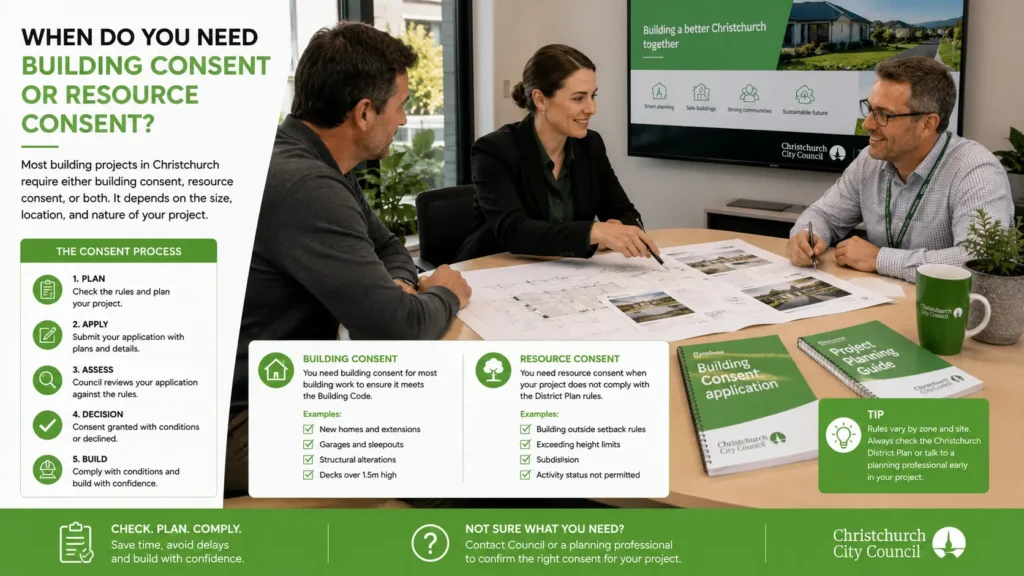
Understanding whether your project requires building consent, resource consent, or both is one of the most important steps before building near a boundary in Christchurch. Many homeowners assume that if a structure is relatively small, they can start building immediately. In reality, consent requirements depend on several factors, including the type of structure, its location on the site, its height, and whether it complies with Christchurch District Plan rules. Knowing which approvals are required early in the planning process can help prevent costly mistakes, redesigns, and construction delays.
Understanding Building Consent Requirements
Building consent is a formal approval issued by the local council that confirms your proposed building work complies with the Building Code. The purpose of building consent is to ensure structures are safe, durable, and suitable for their intended use. Even when a project complies with boundary setback requirements, building consent may still be necessary.
What Building Consent Covers
Building consent focuses on how a structure is designed and constructed rather than where it is positioned on a property. Council building officials assess plans to ensure the proposed work meets technical and safety standards.
Some of the key areas reviewed during the building consent process include:
- Structural Integrity: Ensures foundations, framing, and supporting elements can safely withstand expected loads and environmental conditions.
- Weather-Tightness: Confirms the building can resist moisture penetration and protect occupants from weather-related damage.
- Fire Safety: Reviews fire-resistant materials, escape routes, and separation distances where applicable.
- Health And Safety Requirements: Covers ventilation, sanitation, drainage, and occupant safety standards.
- Building Durability: Verifies that materials and construction methods meet minimum lifespan requirements under the Building Code.
Building consent provides reassurance that the project has been independently assessed before construction begins.
Types Of Projects That Typically Require Consent
While some minor building work may qualify for exemptions, many residential projects require formal approval.
Projects that commonly require building consent include:
- New Homes: Construction of new residential dwellings.
- Home Extensions: Additional rooms, second-storey additions, and significant alterations.
- Detached Garages: Larger garages and workshops that exceed exemption thresholds.
- Sleepouts: Habitable structures intended for accommodation or regular occupancy.
- Structural Alterations: Removal or modification of load-bearing walls and major renovations.
- Decks And Retaining Walls: Depending on height, design, and complexity.
Because exemptions can be subject to specific conditions, it is always wise to confirm requirements before commencing work.
When Resource Consent May Be Required
Resource consent focuses on how a development affects the surrounding environment and neighbouring properties. While building consent addresses construction standards, resource consent assesses compliance with planning rules contained within the Christchurch District Plan.
In many cases, homeowners can build without resource consent if their project remains within permitted activity standards. Resource consent becomes necessary when a proposal exceeds those standards.
Building Outside Permitted Standards
Every property is subject to planning controls that regulate development intensity and land use. If your project exceeds a permitted standard, resource consent may be required before construction can proceed.
Examples include:
- Exceeding Maximum Site Coverage: Building occupies more land than allowed.
- Breaching Outdoor Living Space Requirements: Insufficient private outdoor space remains available.
- Exceeding Height Limits: Buildings extend beyond permitted height controls.
- Non-Complying Land Use Activities: Proposed use differs from zoning requirements.
The council assesses whether the proposal creates adverse effects and whether those effects can be appropriately managed.
Boundary Encroachments
Boundary encroachments occur when a building extends into an area where setbacks are required. Even relatively small encroachments can trigger planning issues.
Common examples include:
- Garage Placement: Garages positioned too close to side or rear boundaries.
- Home Extensions: Additions extending into required setback areas.
- Accessory Buildings: Sheds, workshops, or sleepouts located within restricted zones.
Where encroachments occur, resource consent may be required to assess the impact on neighbouring properties and the surrounding environment.
Height And Setback Infringements
Height and setback controls work together to protect privacy, access to sunlight, and neighbourhood character. A building may comply with one requirement while breaching another.
Potential issues include:
- Recession Plane Breaches: Building height exceeds the allowable angle near a boundary.
- Reduced Setbacks: Structures positioned closer than permitted distances.
- Overshadowing Effects: Development significantly reduces sunlight access for neighbours.
- Visual Dominance: Buildings appear overly large or imposing when viewed from adjacent properties.
These infringements are among the most common reasons homeowners require resource consent when building near boundaries.
What Happens If Your Plans Do Not Meet Setback Rules?
Discovering that a proposed building does not comply with setback requirements does not necessarily mean the project cannot proceed. However, it often introduces additional steps, costs, and approval requirements that can affect timelines and budgets.
Understanding the likely process can help property owners make informed decisions before construction begins.
Consent Application Process
When setback rules are breached, a resource consent application is typically required. The council will review the proposal and assess the effects on neighbouring properties and the wider community.
The process generally involves:
- Preparing Revised Plans: Detailed drawings showing the extent of the infringement.
- Professional Assessment: Planning reports that explain the proposal and potential effects.
- Council Review: Evaluation against relevant District Plan provisions.
- Neighbour Consideration: In some situations, written approval from affected neighbours may be requested.
- Final Decision: Approval, approval with conditions, or refusal.
The complexity of the infringement often influences how long the process takes.
Potential Costs And Delays
Non-compliance can increase both project costs and approval timeframes.
Potential impacts may include:
- Additional Professional Fees: Costs for planners, architects, surveyors, or consultants.
- Council Application Fees: Resource consent processing charges.
- Redesign Costs: Modifications required to achieve compliance.
- Construction Delays: Waiting periods while approvals are assessed.
- Legal Or Survey Expenses: Additional investigations where boundaries are unclear.
Addressing compliance issues before finalising plans is usually more cost-effective than correcting them later.
Importance Of Professional Advice
Boundary setback requirements can be more complex than many homeowners expect. Rules often vary depending on zoning, site shape, topography, easements, and surrounding development patterns.
Seeking professional guidance can provide several advantages:
- Accurate Interpretation: Professionals understand how planning rules apply to specific sites.
- Early Risk Identification: Potential issues can be identified before plans are completed.
- Efficient Design Solutions: Experienced designers can often achieve project goals while maintaining compliance.
- Improved Approval Outcomes: Well-prepared applications are generally easier for councils to assess.
- Reduced Costs: Avoiding redesigns and unnecessary delays can save significant time and money.
Whether you are planning a garage, sleepout, extension, or new home, obtaining expert advice early in the process can help you avoid unexpected complications and move forward with greater confidence.
Understanding the difference between building consent and resource consent is essential when planning any construction project near a boundary in Christchurch. Taking the time to confirm requirements, assess potential setbacks, and seek professional guidance where needed can help ensure a smoother approval process and reduce the risk of costly surprises during construction.
Common Factors That Influence Boundary Building Restrictions
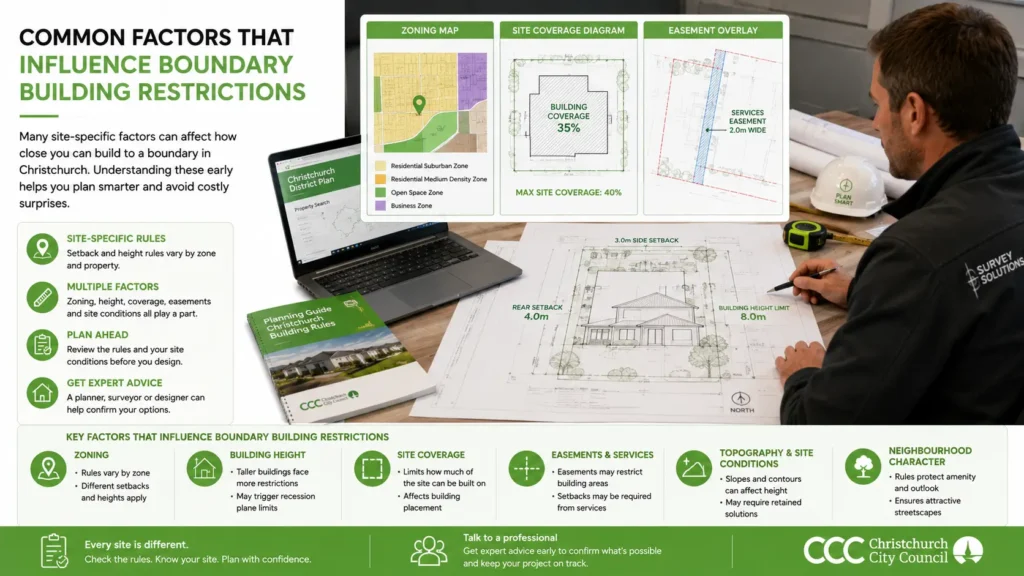
Before starting any construction project, it is important to understand that boundary building restrictions are not determined by setback distances alone. Several planning and legal factors can influence how close you can build to a property boundary in Christchurch. These requirements are designed to balance development opportunities with privacy, safety, access to services, and neighbourhood amenity. Understanding these factors early in the planning process can help you avoid costly redesigns, consent delays, and compliance issues.
Property Zoning And District Plan Rules
Property zoning is one of the most important factors that determines what can be built on a site and where structures can be positioned. Christchurch City Council uses zoning to manage land use and development across different areas of the city. Each zone contains specific rules that affect building setbacks, building heights, site coverage, and density.
The Christchurch District Plan sets out these requirements and provides the framework for how land can be developed. A property located in a suburban residential zone may have different setback requirements from a property in a medium-density residential area or a rural residential zone. Because of these differences, two neighbouring properties may not always be subject to exactly the same building restrictions.
How Zoning Affects Development Rights
Development rights refer to what property owners can legally build on their land without requiring additional planning approvals. Zoning directly influences these rights by establishing limits and standards that guide future development.
- Building Placement: Zoning rules often specify minimum distances that buildings must maintain from front, side, and rear boundaries.
- Housing Density: Some zones permit more intensive development, such as townhouses or multiple dwellings, while others focus on lower-density housing.
- Building Scale: Height limits and recession-plane requirements can vary depending on the zone and intended land use.
- Future Development Potential: Certain zones provide greater flexibility for extensions, secondary dwellings, or redevelopment opportunities.
Christchurch District Plan Considerations
The Christchurch District Plan contains detailed rules that apply to residential and commercial properties throughout the city. Property owners should review the specific provisions that relate to their site before finalising any building plans.
Important considerations may include:
- Setback Requirements: Minimum yard distances from boundaries.
- Height Controls: Maximum permitted building heights.
- Recession Planes: Rules designed to protect sunlight access for neighbouring properties.
- Site Coverage Limits: Restrictions on how much of the site can be occupied by buildings.
- Outdoor Living Space Standards: Requirements for usable outdoor areas on residential properties.
Professional advice from a planner, designer, or architect can help interpret these requirements and identify any potential compliance issues before construction begins.
Existing Easements And Legal Restrictions
Even when a proposed building complies with zoning and setback rules, other legal restrictions may still affect where construction can occur. Easements are one of the most common issues that property owners encounter when planning building projects.
An easement grants another party the legal right to use part of a property for a specific purpose. These rights are usually recorded on the property’s title and can significantly influence building locations.
Drainage Easements
Drainage easements are commonly found on residential properties and allow access to underground stormwater or wastewater infrastructure. Building over these easements can create maintenance difficulties and may not be permitted without approval from the relevant authority.
Property owners should carefully identify the location of any drainage easements before preparing construction plans.
- Infrastructure Protection: Easements help ensure ongoing access to essential drainage systems.
- Building Restrictions: Structures may be prohibited or restricted within easement areas.
- Future Maintenance Access: Utility providers may require access for repairs or upgrades.
Access Easements
Access easements provide legal rights for people or vehicles to cross part of a property to reach another property or shared area. These are particularly common on rear sections, cross-lease developments, and shared driveways.
Building within an access easement can interfere with legal access rights and may create disputes with neighbouring property owners.
- Shared Access: Easements often serve multiple properties.
- Legal Obligations: Property owners must preserve access rights.
- Development Constraints: Building designs may need adjustment to avoid easement areas.
Utility Service Corridors
Utility service corridors accommodate infrastructure such as water, electricity, telecommunications, and gas services. Construction within these areas may require additional approvals or design modifications.
Before beginning any project, property owners should identify existing service locations and confirm whether restrictions apply.
- Service Protection: Utility providers require access to maintain infrastructure.
- Approval Requirements: Some projects may require consultation with service authorities.
- Design Planning: Early identification helps prevent unexpected construction issues.
Site Coverage And Building Height Limits
Site coverage and building height controls work alongside setback requirements to shape how development occurs on a property. These rules help maintain open space, preserve neighbourhood character, and ensure residential properties continue to provide adequate outdoor living environments.
Even if a building meets setback requirements, it may still exceed site coverage or height limits, creating compliance challenges.
Maximum Site Coverage
Site coverage refers to the percentage of a property that can be occupied by buildings. The purpose of site coverage limits is to prevent overdevelopment and ensure sufficient open space remains available.
Exceeding site coverage limits can affect drainage, outdoor usability, and neighbourhood amenity.
- Open Space Preservation: Helps maintain balanced site development.
- Stormwater Management: Reduces excessive hard-surface coverage.
- Neighbourhood Character: Supports consistent development patterns within residential areas.
- Compliance Requirements: Excessive building footprints may require additional approvals.
Property owners should consider all existing and proposed structures when calculating site coverage, including garages, sleepouts, and other accessory buildings.
Outdoor Living Space Requirements
Many residential zones require properties to provide a minimum amount of usable outdoor living space. These areas support recreation, relaxation, and general residential amenity.
Outdoor living space requirements often influence building placement and overall site layout.
- Usability: Areas should be practical and accessible.
- Sunlight Access: Outdoor spaces are typically expected to receive reasonable sunlight exposure.
- Residential Amenity: Adequate outdoor areas contribute to property functionality and liveability.
- Planning Compliance: Failure to meet requirements may affect consent outcomes.
Relationship Between Setbacks And Overall Site Planning
Setbacks should not be viewed as isolated rules. They work together with site coverage limits, building heights, outdoor living space standards, and recession-plane requirements to create a balanced development framework.
Successful site planning considers all these factors from the beginning rather than addressing them individually later in the design process.
A well-planned project will typically achieve compliance while still meeting the owner’s practical needs and development goals. Early consultation with design professionals, surveyors, and planning specialists can often identify opportunities to maximise usable space while remaining within Christchurch’s planning framework.
Understanding zoning rules, easements, site coverage limits, and building-height controls can save significant time and expense during the planning stage. By reviewing these factors before construction begins, property owners can reduce the risk of consent issues, protect future development opportunities, and create building designs that work effectively within Christchurch’s regulatory environment.
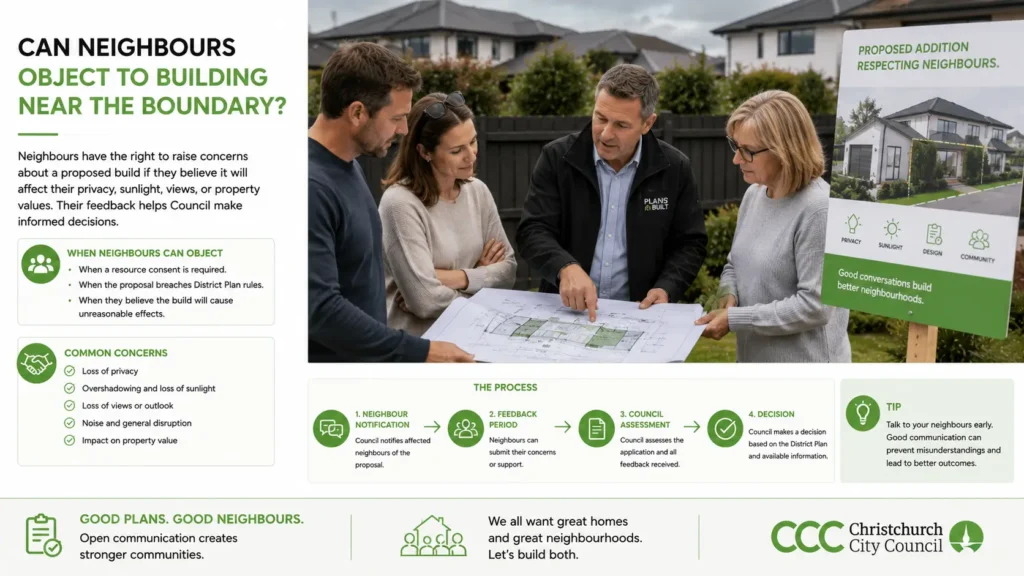
Can Neighbours Object To Building Near The Boundary?
Building close to a property boundary often raises questions about how neighbouring property owners may be affected. While many building projects can proceed without direct neighbour approval when they fully comply with Christchurch planning rules, there are situations where neighbours may become involved in the process. Understanding when neighbour input may be required and how potential concerns are assessed can help property owners avoid delays, reduce conflict, and maintain positive relationships throughout a construction project.
Situations Where Neighbour Approval May Be Needed
Not every building project requires neighbour involvement. However, if a proposal does not meet certain planning standards, the Christchurch City Council may consider whether nearby property owners could be adversely affected.
Consent-Related Neighbour Consultation
When a project requires resource consent due to a breach of setback requirements, recession planes, or other planning controls, neighbour consultation may become part of the approval process. The council will assess the scale and nature of any potential effects on surrounding properties before deciding whether affected parties should be consulted.
Some common situations where consultation may arise include:
- Boundary Encroachments: Buildings proposed closer to the boundary than permitted under the district plan.
- Excessive Building Height: Structures that exceed height limits or recession-plane requirements.
- Overshadowing Risks: Developments that may significantly reduce sunlight access to neighbouring properties.
- Privacy Concerns: Elevated decks, balconies, or windows that overlook adjacent outdoor living spaces.
The need for consultation is generally determined by the specific circumstances of the project rather than a blanket requirement for all developments.
Written Approvals
In some cases, obtaining written approval from an affected neighbour can support a resource consent application. A written approval indicates that the neighbour has reviewed the proposal and does not object to the potential effects identified.
Written approvals can be beneficial because:
- Simplified Assessment: The council may disregard certain effects on neighbours who have provided approval.
- Faster Processing: Consent applications may progress more smoothly when concerns have already been addressed.
- Reduced Uncertainty: Property owners gain greater clarity about potential objections early in the process.
It is important that neighbours receive accurate information about the proposed development before providing any approval.
Privacy, Shading, And Visual Impact Concerns
Neighbour objections are often linked to concerns about how a proposed building may affect daily living conditions. Councils carefully evaluate these concerns when reviewing resource consent applications.
Common Neighbour Objections
Most objections relate to practical impacts rather than the construction itself. Neighbours may be concerned about changes that affect their property’s enjoyment, value, or functionality.
Common concerns include:
- Loss Of Privacy: New windows, decks, balconies, or elevated living spaces overlooking neighbouring properties.
- Reduced Sunlight: Buildings that create excessive shading over gardens, outdoor areas, or living spaces.
- Visual Dominance: Large structures that appear overwhelming due to their scale or proximity to the boundary.
- Construction Disruption: Noise, dust, traffic, and temporary inconvenience during building work.
- Property Access Issues: Potential interference with shared driveways, easements, or access points.
These concerns do not automatically prevent development, but they can influence how a proposal is assessed.
How Councils Assess Impacts
When reviewing a proposal, councils typically focus on whether the effects on neighbouring properties are reasonable and acceptable within the context of the surrounding area.
Assessment factors may include:
- Degree Of Impact: How significant the privacy, shading, or visual effects are likely to be.
- Neighbourhood Character: Whether the proposal aligns with the scale and appearance of nearby development.
- Mitigation Measures: Design features that reduce adverse effects, such as screening, setbacks, or adjusted building heights.
- Site Conditions: Property orientation, topography, and existing development patterns.
The assessment process aims to balance property owners’ development rights with the interests of neighbouring residents.
Best Practices For Maintaining Good Neighbour Relationships
Even when neighbour approval is not legally required, maintaining open communication can make the building process smoother and less stressful for everyone involved.
Early Communication
One of the most effective ways to prevent disputes is to speak with neighbours before construction begins. Early discussions allow property owners to explain their plans, answer questions, and identify potential concerns before they become larger issues.
Benefits of early communication include:
- Building Trust: Demonstrates consideration and transparency.
- Identifying Concerns Early: Provides an opportunity to address issues before plans are finalised.
- Reducing Misunderstandings: Prevents incorrect assumptions about the scope of the project.
Many disputes arise not because of the building itself but because neighbours feel uninformed or excluded from the process.
Sharing Plans
Providing neighbours with a simple overview of the proposed development can help them better understand what to expect. This may include site plans, elevations, timelines, or visual representations of the project.
Useful information to share may include:
- Project Scope: The type and size of the proposed structure.
- Construction Timeline: Expected start and completion dates.
- Working Hours: When contractors will be on site.
- Access Arrangements: How deliveries and construction activities will be managed.
Transparency often reduces uncertainty and promotes cooperation.
Avoiding Disputes During Construction
Even well-planned projects can create temporary inconvenience. Taking reasonable steps to minimise disruption can help preserve positive neighbour relationships throughout the construction period.
Practical measures include:
- Managing Noise: Following approved construction hours and minimising unnecessary disturbance.
- Maintaining Site Safety: Ensuring materials and equipment remain contained within the work site.
- Keeping Communication Open: Providing updates when major construction activities are scheduled.
- Responding Promptly: Addressing neighbour concerns respectfully and professionally when they arise.
A proactive approach can prevent small issues from developing into formal complaints or long-term disagreements.
Building near a boundary does not automatically lead to neighbour objections, but understanding how planning rules, consent processes, and neighbour concerns interact can help you make informed decisions. By communicating early, considering potential impacts, and following Christchurch’s planning requirements, property owners can reduce the likelihood of disputes while keeping their projects on track.
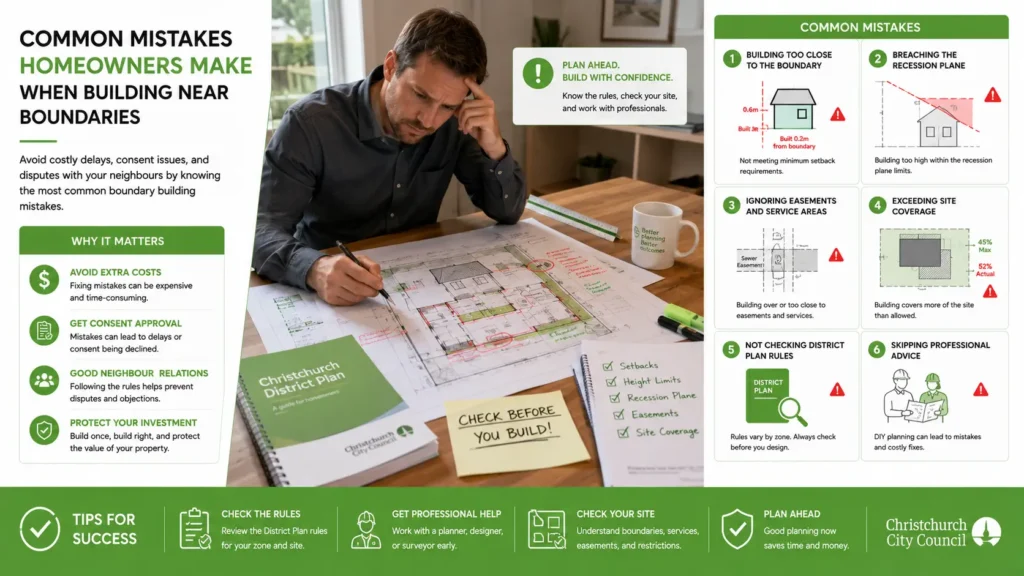
Common Mistakes Homeowners Make When Building Near Boundaries
Building near a property boundary may seem straightforward, but many homeowners run into problems because they assume the rules are simple or the same for every site. Christchurch properties are subject to planning controls that can vary based on zoning, building height, site dimensions, and other factors. Failing to understand these requirements before construction begins can lead to costly delays, redesigns, consent applications, and disputes. Knowing the most common mistakes can help you avoid unnecessary complications and keep your project on track from the start.
Assuming All Properties Follow The Same Rules
One of the most common mistakes homeowners make is assuming that boundary setback requirements are identical across Christchurch. While general rules may apply in some situations, every property has unique characteristics that can affect what can and cannot be built.
Different zones within Christchurch often have different planning requirements. A property located in a suburban residential area may be subject to different setback distances and height controls than a property in a medium-density residential zone or a rural-residential area. Site-specific factors can also influence what is permitted.
Important variables that may affect boundary rules include:
- Property Zoning: Different zones have their own development standards, setback requirements, and density controls.
- Lot Size: Smaller sections may have different design constraints compared to larger properties.
- Site Shape: Irregularly-shaped sites can create unique compliance challenges that standard rules do not always address.
- Corner Sites: Properties with multiple road frontages often have additional setback considerations.
- Existing Structures: Existing buildings on the site can affect available building space and compliance requirements.
Before designing a project, it is important to review the specific rules that apply to your property rather than relying on information from neighbouring homes or general assumptions.
Ignoring Recession Plane Requirements
Recession planes are frequently misunderstood by homeowners planning extensions, garages, sheds, or new homes. While many people focus on setback distances, they often overlook the fact that building height near a boundary can be just as important.
A recession plane is an imaginary angle that extends upward from a property boundary. Its purpose is to help preserve access to sunlight and daylight for neighbouring properties. Even if a building meets setback requirements, it may still breach recession plane controls if it extends too high.
Ignoring recession plane requirements can create several problems:
- Design Revisions: Plans may need significant alterations to reduce building height or change roof designs.
- Additional Costs: Architectural and engineering changes can increase project expenses.
- Consent Requirements: A recession plane breach may require resource consent.
- Project Delays: Approval processes can extend construction timelines significantly.
Many homeowners discover recession plane issues after plans have already been prepared. Reviewing these restrictions during the early design stage can prevent expensive redesigns later in the process.
Starting Construction Before Confirming Compliance
Some property owners begin construction based on assumptions or informal advice without first confirming whether their plans meet Christchurch planning and building requirements. This approach can create serious legal and financial consequences.
Building compliance involves more than measuring the distance from a boundary. Height limits, site coverage, outdoor living space requirements, easements, and consent obligations may all influence whether a project is permitted.
Potential risks include:
- Enforcement Action: Christchurch City Council may investigate unauthorised work that does not comply with applicable rules.
- Stop Work Orders: Construction may be halted until compliance issues are resolved.
- Retrospective Consents: Additional applications may be required after work has already commenced.
- Removal Requirements: Non-compliant structures may need modification or partial removal.
- Financial Losses: Delays, professional fees, and corrective work can increase overall project costs.
Confirming compliance before construction begins is generally far less expensive than resolving problems after building work is underway.
Overlooking Easements And Existing Restrictions
Many homeowners focus entirely on setback requirements and overlook restrictions that exist on the property’s title. Easements and other legal encumbrances can affect where structures can be placed, even when they appear to meet planning requirements.
An easement grants certain rights over part of a property, often for infrastructure or access purposes. Building over these areas may not be permitted without approval from the relevant authority or utility provider.
Common restrictions include:
- Drainage Easements: Protect underground stormwater and wastewater infrastructure.
- Access Easements: Allow neighbouring properties legal access across part of the land.
- Utility Easements: Cover power, telecommunications, or water services.
- Consent Notices: May impose ongoing development restrictions on the property.
- Covenants: Private agreements that can limit building locations, heights, or design features.
A title review is one of the most important steps before planning any boundary-related construction. Understanding these restrictions early can prevent expensive design changes and reduce the risk of unexpected legal issues during the approval process.
Taking the time to understand boundary setbacks, recession planes, easements, and zoning requirements before building can save considerable time, money, and stress. Careful planning and professional advice can help ensure your project complies with Christchurch regulations while avoiding the common mistakes that often lead to delays and unnecessary costs.
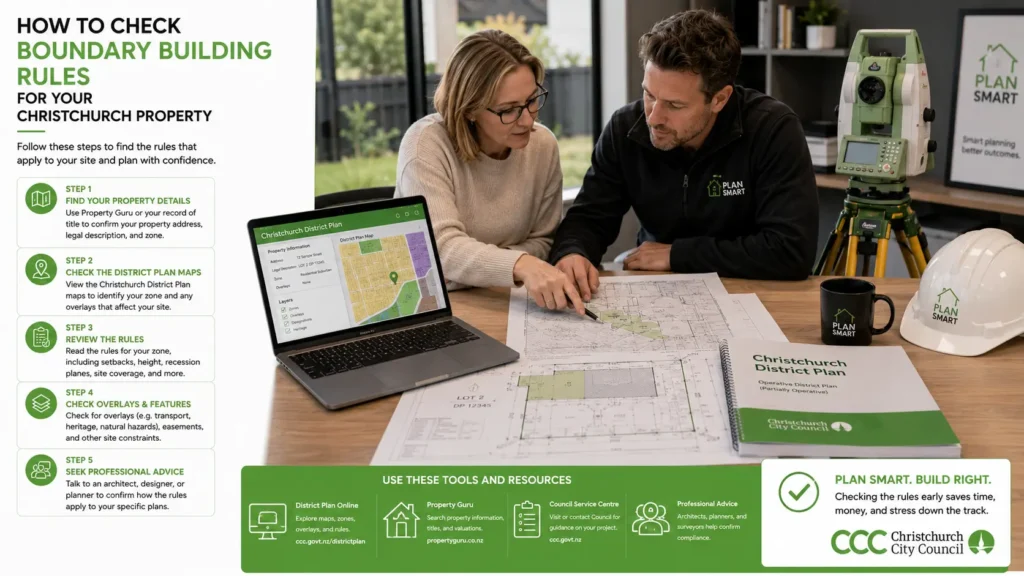
How To Check Boundary Building Rules For Your Christchurch Property
Before starting any construction project, it is important to understand the rules that apply to your specific property. Boundary setbacks, recession planes, easements, and zoning requirements can all influence how close you can build to a boundary in Christchurch. Taking the time to verify these requirements early can help prevent costly design changes, consent delays, and disputes later in the process. Property owners who understand the applicable rules from the beginning are usually in a much stronger position to plan a compliant and efficient building project.
Reviewing Christchurch District Plan Requirements
The Christchurch District Plan is one of the most important resources for understanding what can and cannot be built on a property. It contains the planning rules that guide residential, commercial, and rural development throughout the city. These rules help manage land use, protect neighbouring properties, and ensure that development occurs in a way that supports the wider community.
Where To Find Relevant Information
The Christchurch City Council provides access to planning information through its website and online planning tools. Property owners can search for their address and review the zoning and planning controls that apply to their land.
When reviewing planning information, it is important to focus on the rules that affect building location, height, and site development.
- Property Zoning: Determines the development standards that apply to your site and can influence setback distances and building design requirements.
- Setback Requirements: Specifies the minimum distance buildings must be positioned from side, rear, and front boundaries.
- Recession Plane Controls: Limits how high structures can be built close to neighbouring properties.
- Site Coverage Rules: Restricts the percentage of the site that can be covered by buildings and structures.
- Special Planning Overlays: Identifies additional controls that may apply to heritage areas, natural hazards, or other protected zones.
Checking these requirements before preparing plans can save significant time and reduce the risk of designing a project that does not comply with local planning standards.
Key Planning Documents
Several planning documents may be relevant when assessing boundary building rules. While the District Plan is often the primary source of information, additional documents may also affect development opportunities.
- Christchurch District Plan: Contains zoning rules, setback requirements, recession planes, and development standards.
- Property Records: May reveal site-specific conditions that affect future construction.
- Land Information Memorandum (LIM): Provides information about planning restrictions, hazards, and council records associated with the property.
- Certificate Of Title: Identifies ownership details, easements, covenants, and legal restrictions affecting the land.
- Engineering And Infrastructure Information: May identify underground services, drainage infrastructure, or access restrictions.
Reviewing these documents together provides a more complete understanding of the constraints and opportunities associated with a property.
Consulting A Designer, Architect, Or Planner
While many planning resources are publicly available, interpreting them correctly is not always straightforward. Professional advice can be particularly valuable when dealing with complex sites, unusual property layouts, or projects that push close to planning limits.
Benefits Of Professional Guidance
Experienced designers, architects, and planners work with planning rules regularly and understand how different requirements interact. Their expertise can help property owners make informed decisions before investing in detailed plans or construction.
- Accurate Interpretation: Professionals can explain how planning controls apply to your specific site.
- Practical Design Solutions: They can recommend design adjustments that improve compliance without compromising functionality.
- Efficient Project Planning: Early advice often helps streamline approvals and reduce delays.
- Risk Reduction: Potential planning issues can be identified before construction documents are prepared.
- Improved Project Outcomes: Professional input can lead to more efficient site layouts and better use of available space.
Seeking advice early is often more cost-effective than redesigning a project after problems have been identified.
Avoiding Compliance Issues Early
Many boundary-related problems arise because planning restrictions were overlooked during the initial design stage. Once plans are completed, correcting these issues can become expensive and time-consuming.
Professionals can review proposed designs against relevant planning controls and identify areas that may require modification before consent applications are submitted.
- Boundary Encroachments: Ensures buildings remain within required setback distances.
- Height Compliance: Verifies that proposed structures satisfy recession plane requirements.
- Consent Requirements: Identifies whether resource consent may be required before construction begins.
- Easement Protection: Prevents conflicts with legal access rights and underground services.
- Neighbour Impact Assessment: Helps reduce potential concerns relating to shading, privacy, or visual effects.
Addressing these matters early often leads to a smoother approval process and fewer unexpected complications.
Confirming Property Boundaries Before Building
Even when plans comply with planning rules, it is still essential to confirm the exact location of property boundaries. Building too close to a boundary due to inaccurate assumptions can create significant legal and financial issues.
Importance Of Land Surveys
A professional land survey provides an accurate representation of property boundaries and site dimensions. Survey information is particularly valuable when planning construction close to a boundary or when existing boundary markers are unclear.
- Boundary Accuracy: Confirms the exact location of legal property lines.
- Site Measurement Verification: Provides reliable dimensions for design and construction purposes.
- Development Confidence: Reduces uncertainty when positioning buildings near boundaries.
- Consent Support: Assists designers and consultants when preparing plans and documentation.
- Future Property Transactions: Creates a reliable record that may be useful for future development or sale activities.
Survey information provides a strong foundation for informed decision-making throughout the planning process.
Preventing Boundary Disputes
Boundary disputes can arise when structures are built in the wrong location or when neighbouring owners disagree about where property lines exist. These disputes can delay projects, increase costs, and damage relationships between neighbours.
Taking proactive steps before construction begins can help avoid these situations.
- Survey Verification: Confirms boundaries before finalising construction plans.
- Clear Communication: Allows neighbours to understand the proposed development.
- Accurate Building Placement: Helps ensure structures remain within legal property limits.
- Documentation Retention: Maintains records that can be referenced if questions arise in the future.
- Professional Advice: Provides guidance when boundary locations or legal rights are unclear.
A small investment in boundary verification can prevent much larger problems later in the building process.
Understanding the boundary building rules that apply to your Christchurch property is one of the most important steps in successful project planning. By reviewing the relevant planning documents, seeking professional guidance where needed, and confirming property boundaries before construction begins, you can reduce risk, improve compliance, and move forward with greater confidence.
Planning to build near a boundary and want to avoid costly delays or compliance issues? Our team can help you understand Christchurch setback requirements, consent obligations, and site-specific restrictions before construction begins. Get expert guidance tailored to your project so you can move forward with confidence, make informed decisions, and ensure your plans meet local regulations from the start.
References
- Christchurch City Council Building and Planning Information
https://ccc.govt.nz/consents-and-licences/resource-consents - Building Performance New Zealand Building Consents Guide
https://www.building.govt.nz/projects-and-consents/building-consents - Building Performance Exempt Building Work Guidance
https://www.building.govt.nz/building-code-compliance/b-stability/b1-structure/exempt-building-work - New Zealand Legislation Building Act 2004
https://www.legislation.govt.nz/act/public/2004/0072/latest/DLM306036.html
FAQs: About How Close To The Boundary Can I Build Christchurch
How close to the boundary can I build in Christchurch?
The distance you can build from a boundary depends on your property’s zoning, building type, and Christchurch District Plan requirements. Side, rear, and front yard setbacks may apply, along with recession plane rules that restrict building height near boundaries.
Do all Christchurch properties have the same setback requirements?
No. Setback requirements can vary based on zoning, site size, property location, and specific planning controls. Residential, rural, and higher-density zones often have different standards that affect how close structures can be built to boundaries.
What is a recession plane and why does it matter?
A recession plane is an imaginary angle extending upward from a boundary that helps protect neighbouring properties from excessive shading. Buildings must generally fit within this plane unless resource consent is obtained.
Can I build a garage right next to my boundary?
In some cases, garages may be built close to a boundary if they meet permitted height and design requirements. The exact rules depend on the property’s zoning and whether the structure complies with setback and recession plane standards.
Do I need building consent to build near a boundary?
Many structures require building consent, particularly larger buildings, garages, and home extensions. Consent requirements depend on the size, complexity, and intended use of the project, as well as compliance with building regulations.
When is resource consent required for boundary building projects?
Resource consent may be required if your proposal does not meet setback requirements, exceeds permitted building heights, or breaches recession plane rules. The council will assess the potential impact on neighbouring properties before approval.
Can my neighbour stop me from building near the boundary?
Neighbours cannot automatically stop a compliant building project. However, if resource consent is required and the development may affect them, their written approval or feedback could become part of the assessment process.
How can I find the setback rules for my property?
You can review the Christchurch District Plan, consult Christchurch City Council resources, or seek advice from a planner, architect, or designer. A professional review can help identify site-specific restrictions before construction begins
Do sheds and sleepouts have different boundary rules?
Yes. Smaller accessory buildings such as sheds may be subject to different requirements than habitable buildings like sleepouts. Factors such as height, floor area, and intended use can affect the applicable rules.
What happens if I build too close to a boundary without approval?
Building too close to a boundary without meeting legal requirements can result in enforcement action, additional consent costs, project delays, or expensive modifications. Verifying compliance before construction begins is usually far more cost-effective than correcting issues later.
Conclusion
Before starting any construction project, it is important to understand how Christchurch’s boundary setback rules, recession-plane requirements, zoning regulations, and consent obligations may affect your plans. Even small structures such as garages, sheds, and sleepouts can be subject to site-specific restrictions that vary from one property to another. Taking the time to review the Christchurch District Plan, confirm property boundaries, and identify any easements or legal constraints can help prevent costly delays, redesigns, and compliance issues later in the process. If you are unsure about the rules that apply to your site, consulting a qualified designer, surveyor, or planning professional can provide valuable guidance and help ensure your project meets Christchurch building and planning requirements before construction begins.